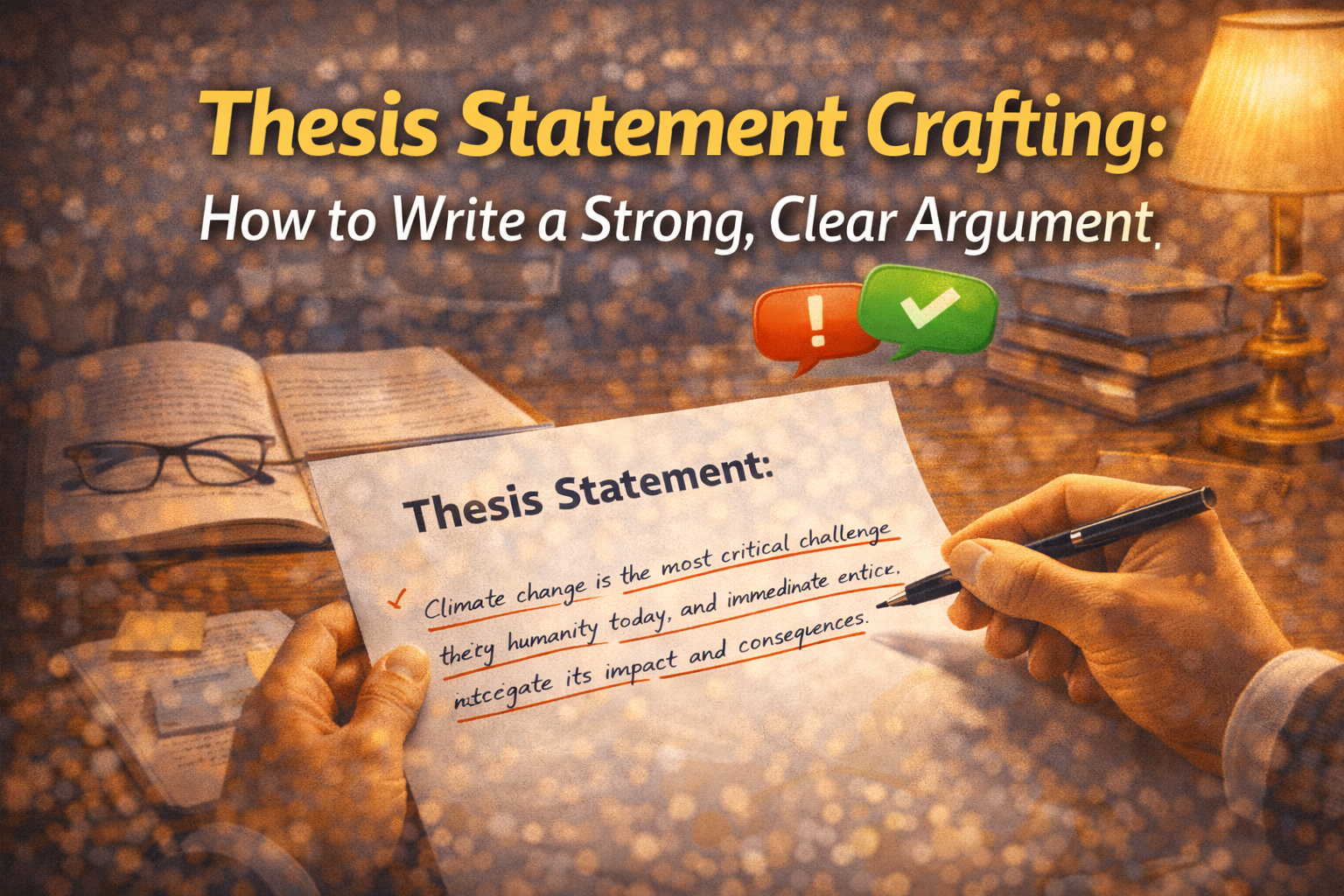
Introduction: The One Sentence That Makes or Breaks Your Entire Argument
Imagine building a house without a foundation. That’s what writing an essay or speech is like without a strong thesis statement. You can have beautiful language, compelling evidence, and elegant structure, but if your core argument is weak, everything collapses.
The thesis statement is the single most important sentence you will write. It is the North Star for your entire piece. Every paragraph, every example, every word should point back to proving this one, central claim.
But here’s what most guides don’t tell you: A thesis statement is not a fact. It is an act of intellectual courage. It’s you saying, “This is what I believe, and here is how I will prove it.” That’s why it’s so hard—and so powerful.
In this guide, I’ll demystify the process. I’ll give you clear formulas, show you the difference between weak and strong theses, and teach you how to test your own. By the end, you’ll be able to craft a thesis that gives your writing direction, power, and purpose.
Part 1: What a Thesis Statement IS (And What It Is NOT)
Let’s clear up the confusion first. Many students get this wrong because they misunderstand the goal.
A Strong Thesis Statement IS:
- An Argument: A claim that must be proven.
- Specific: Names your main points or angle.
- Debatable: Reasonable people could disagree with it.
- A Roadmap: Gives the reader a preview of your logic.
A Weak Thesis Statement is OFTEN:
- A Fact: A statement of undisputed truth.
- A Vague Announcement: Just says what the topic is.
- A Personal Preference: States an opinion without an argument.
- A Question: Poses an inquiry but takes no position.
The Quick Test: If someone can respond with “Okay… so what?” or “Prove it,” you have a potential thesis. If they can only say “Yes, that’s true,” you have a fact.
Part 2: The Anatomy of a Powerful Thesis (The 3 Must-Have Elements)
A strong thesis is like a mathematical formula. It has specific components that work together.
1. The Topic: What are you writing about? (e.g., social media, renewable energy, Shakespeare’s Hamlet)
2. The Claim/Position: What is your specific, arguable opinion about the topic?
3. The Blueprint (Reasoning): What are the main points (usually 2-3) you will use to prove your claim?
Put them together:
[Topic] + [Claim/Position] + [Blueprint] = Strong Thesis
Part 3: The Step-by-Step Crafting Process
You don’t just think of a thesis. You build it. Follow these four steps.
Step 1: Start with Your Topic and a Question
From your brainstorming, you have a topic. Now, turn it into a research question.
- Topic: The effects of social media on teenagers.
- Question: Is social media ultimately harmful or beneficial for teenagers’ development?
Step 2: Take a Tentative Position (The “Working Thesis”)
Based on your initial research or gut feeling, answer your question. This is your first draft thesis.
- “Social media is harmful for teenagers.”
This is a start, but it’s weak. It’s vague and has no blueprint.
Step 3: Ask “How?” or “Why?” – Add the Blueprint
- HOW is it harmful?
- WHY do I think it’s harmful?
Jot down 2-3 main reasons from your research or logic. - Reason 1: It increases anxiety through comparison.
- Reason 2: It disrupts sleep patterns.
- Reason 3: It weakens face-to-face social skills.
Step 4: Refine for Specificity and Argument
Combine your position with your blueprint to create a sophisticated, arguable thesis.
- Final Thesis: “While social media offers connection, its net impact on teenagers is harmful, as evidenced by its correlation with increased anxiety, sleep deprivation, and the erosion of in-person social competencies.”
Notice what we did: We acknowledged a counterpoint (“offers connection”), made a clear claim (“net impact… is harmful”), and provided a specific 3-part blueprint for the essay.
Part 4: Examples: From Weak to Strong
Let’s transform weak statements into strong theses.
Example 1: Literary Analysis
- Topic: F. Scott Fitzgerald’s The Great Gatsby
- Weak/Vague: “This essay is about the American Dream in The Great Gatsby.” (This is an announcement, not an argument.)
- Weak/Obvious: “Jay Gatsby pursues the American Dream.” (This is a plot fact.)
- Strong & Arguable: “In The Great Gatsby, F. Scott Fitzgerald critiques the corrupting nature of the American Dream by portraying Gatsby’s rise as fueled by crime and his ultimate destruction by the very wealth and status he sought.” (Clear claim + specific blueprint.)
Example 2: Persuasive/Argumentative Essay
- Topic: School uniforms
- Weak/Too Broad: “School uniforms have pros and cons.” (Takes no position.)
- Weak/Simple: “School uniforms are a good idea.” (Vague, no reasoning.)
- Strong & Arguable: “Mandatory school uniforms should be adopted because they reduce socio-economic bullying, foster a focused learning environment, and simplify morning routines for families.” (Clear position + 3-part blueprint.)
Example 3: Expository/Informative Essay
- Topic: The Cuban Missile Crisis
- Weak: “This paper will discuss the Cuban Missile Crisis.” (Announcement.)
- Strong: “The resolution of the Cuban Missile Crisis was primarily due to President Kennedy’s combination of decisive naval action and secret, diplomatic compromise, which set a crucial precedent for Cold War crisis management.” (This makes an informative claim that the essay will explain and substantiate.)
Part 5: Formulas for Different Essay Types
Use these templates to get started.
1. Persuasive/Argumentative Formula:
*” [Subject] should/should not [change/action] because of [Reason 1], [Reason 2], and [Reason 3].”*
- Example: “Plastic water bottles should be banned on campus to reduce environmental waste, cut university costs, and promote student health.”
2. Analytical (Literary, Historical, etc.) Formula:
*”Through an examination of [Aspect 1], [Aspect 2], and [Aspect 3], it is clear that [Subject] demonstrates/explores/criticizes [Your Overall Claim].”*
- Example: “Through its contrasting settings of the jungle and the village, Chinua Achebe’s Things Fall Apart powerfully explores the traumatic clash between traditional Igbo culture and the forces of colonial change.”
3. Compare & Contrast Formula:
“While [Subject A] and [Subject B] share [similarity], they differ fundamentally in [Key Difference 1] and [Key Difference 2], leading to [broader implication].”
- Example: “While both classical and operant conditioning explain learned behavior, they differ fundamentally in the role of the learner’s awareness and the timing of the stimulus, making operant conditioning more effective for shaping complex human behaviors.”
Part 6: The Final Tests (Does Your Thesis Pass?)
Before you start writing, put your thesis statement through these two tests.
1. The “So What?” Test:
Read your thesis. Would a curious reader ask, “So what? Why does that matter?” If yes, your thesis may not be significant enough. A strong thesis implies its own importance.
- Fails: “Dogs make good pets.” (So what?)
- Passes: “Training a dog as a pet can significantly improve an owner’s physical health and social connectedness, challenging the notion of pet ownership as a one-way relationship.”
2. The “How and Why?” Test:
Can you immediately see the “how” and “why” of your argument from the thesis itself? The blueprint should point to your body paragraphs.
- Fails: “Climate change is bad.” (How? Why?)
- Passes: “Anthropogenic climate change poses an existential threat not merely through rising temperatures, but through its cascading effects on global food security, mass migration patterns, and the increased likelihood of regional conflicts.” (The “how” is clear: food, migration, conflict.)
Conclusion: Your Thesis is Your Promise
Crafting a strong thesis is the most important intellectual work you’ll do for your essay or speech. It forces you to clarify your thoughts, take a stand, and map your evidence. When you have a solid thesis, the writing process becomes an act of discovery and proof, not a wandering search for a point.
Remember: Your thesis is a promise to your reader. The rest of your piece is you keeping that promise.
Your Next Step: Go back to an old essay or a topic you’re planning. Look at the thesis. Does it pass the tests? Try to rewrite it using the formulas above. That single act of revision will clarify your entire argument.
Let’s Craft a Thesis Together (Comment Below!):
Take one of these topics (or use your own):
- Topic A: The influence of artificial intelligence on future jobs.
- Topic B: The most important theme in the novel To Kill a Mockingbird.
- Topic C: Whether homework should be abolished.
In the comments:
- Write a weak thesis for your chosen topic.
- Then, write a strong thesis using the formula and principles from this guide.
- Explain one way you could support it (what would be one blueprint point?).
I’ll provide feedback and help you hone your argumentative edge!
