Introduction: The Essay That Doesn’t Just See—It X-Rays
Most essays tell you what happens. An analytical essay tells you why and how it matters. It’s the difference between saying “This character dies” and revealing “This character’s death is the engine of the entire plot’s critique of societal indifference.”
This type of essay is where you move from being a reader to being a critic, a detective, and an interpreter. It’s challenging because it demands you dismantle a text—a poem, a novel, a painting, a film—to see the gears turning inside. Many students stumble by simply summarizing the plot or listing literary devices without tying them to a larger, arguable point.
The secret? An analytical essay isn’t about the text. It’s about your unique argument about the text. The text is your evidence, not your subject.
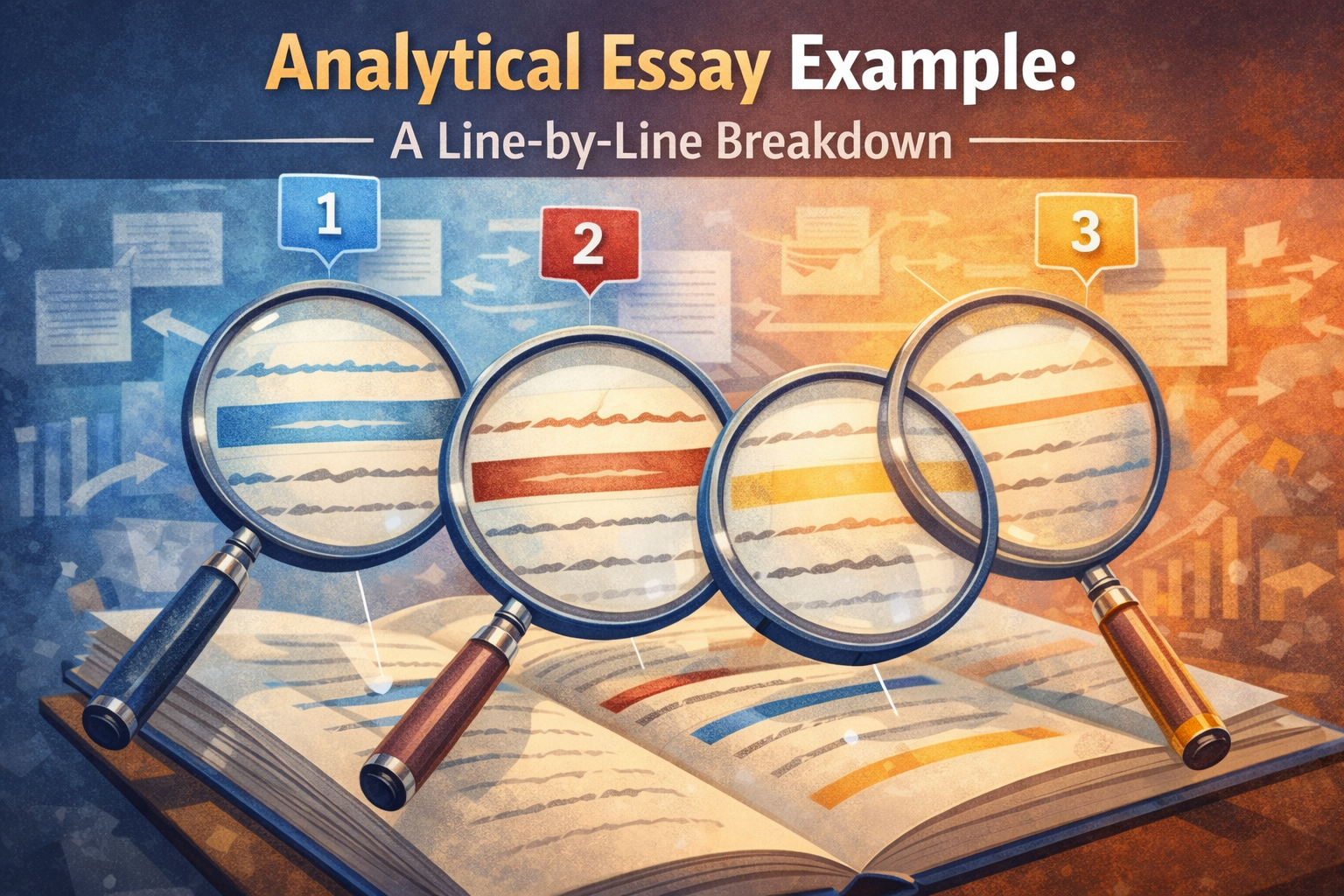
In this guide, I won’t just give you an example and wish you luck. I will dissect one, line-by-line, showing you the exact moves that transform observation into analysis. We’ll use a classic short story, Shirley Jackson’s “The Lottery,” as our subject. By the end, you’ll see the blueprint behind the prose and be able to apply it to any analytical task.
Part 1: What We’re Analyzing & Our Core Argument
The Text: Shirley Jackson’s short story “The Lottery” (1948).
The Prompt: Analyze how Shirley Jackson uses symbolism in “The Lottery” to critique blind adherence to tradition.
Our Thesis (The Argument We’ll Prove):
In “The Lottery,” Shirley Jackson employs the symbolic weight of the black box, the slips of paper, and the lottery ritual itself to expose the profound violence and irrationality embedded in unquestioned societal traditions.
This thesis is strong because it is:
- Arguable: Someone could focus on other elements (setting, character).
- Specific: Names three specific symbols (black box, papers, ritual).
- Demonstrable: Points directly to evidence in the text.
Part 2: The Full Analytical Essay Example
Below is a complete, short-form analytical essay. The comments in [bold brackets] are my line-by-line breakdown of why each part works.
Title: The Boxed-In Society: Symbolism of Conformity in “The Lottery”
Introduction Paragraph
Shirley Jackson’s “The Lottery” remains a chilling masterpiece not for its graphic violence, but for the mundane horror of its premise: a peaceful village conducting an annual ritual murder. Jackson’s power lies in her subversion of seemingly benign symbols, transforming ordinary objects into vessels of terror. [Hook: Starts with the story’s enduring relevance and central paradox—mundane horror.] Through her deliberate symbolic use of the deteriorating black box, the neutral slips of paper, and the ritualized lottery process, Jackson constructs a devastating critique of traditions that persist not through wisdom, but through fear, habit, and the suppression of individual conscience. [Thesis: Clearly states the argument and previews the three symbolic elements to be analyzed. It frames the analysis (a “devastating critique”) and names the mechanisms (“fear, habit, suppression”).]
Body Paragraph 1: Analyzing the Black Box
The black box, the physical centerpiece of the lottery, serves as the story’s most potent symbol of a corrupted and fragile tradition. [Topic Sentence: Directly connects one symbol (black box) to the thesis’s claim about tradition.] Jackson notes it is “shabby,” “splintered,” and no longer even truly black, having faded over time. [Evidence: Provides specific, descriptive quotes from the text.] This deterioration is not incidental; it symbolizes the decay of the ritual’s original meaning and function. [Analysis: This is the crucial step—it explains what the evidence means.] The villagers cling to the box not out of reverence, but out of a superstitious fear of change, as shown by the whispered talk of replacing it that “always faded off without anything being done.” [More Evidence & Analysis: Uses another quote and immediately ties it to the concept of “fear of change,” proving the topic sentence.] Thus, the box represents tradition itself: oppressive, illogical, and maintained not by its own strength, but by the collective anxiety of those who cannot imagine breaking free from it. [Concluding Sentence: Summarizes the paragraph’s argument and links it back to the thesis’s broader critique.]
Body Paragraph 2: Analyzing the Slips of Paper
Jackson further deepens her critique by using the slips of paper to symbolize the false equality and random cruelty of the ritual. [Topic Sentence: Introduces the second symbol and links it to a new aspect of the critique (“false equality, random cruelty”).] On the surface, the papers are identical, and every family head draws one, suggesting a fair, democratic process. [Observation: Sets up the surface-level, “literal” reading.] However, this neutrality is a veneer. The single marked paper—the one with the black spot—transforms an ordinary scrap into a death warrant. [Contrast & Analysis: Introduces the “however” to show the deeper meaning. The analysis shows how the symbol works ironically.] Jackson highlights this shift when Tessie Hutchinson, upon seeing the spot on her paper, screams, “It wasn’t fair!” [Evidence: Powerful, thematic quote used as proof.] Her cry reveals the truth: the ritual’s illusion of fairness masks a brutal, arbitrary selection. The papers symbolize how systems can use the trappings of fairness (“everyone draws”) to legitimize inherent injustice, making victims complicit in their own potential destruction until they are the ones chosen. Analysis & Conclusion: Sophisticated analysis connecting the symbol to systemic injustice and complicity, advancing the thesis.
Body Paragraph 3: Analyzing the Ritual Process
Ultimately, the symbolism of the entire lottery ritual lies in its stark contrast between orderly procedure and barbaric outcome. [Topic Sentence: Focuses on the “ritual” as a macro-symbol, tying it to the key contrast of order/barbarism.] Jackson meticulously details the steps: the assembly of families, the official swearing-in, the precise rules for drawing. [Evidence: References the text’s detailed procedure.] This procedural normalcy makes the horrific climax—the stoning of a neighbor—possible. The symbolism here is in the juxtaposition: the community uses the language and form of civic duty (“lottery in June, corn be heavy soon”) to sanction murder. [Analysis: Explains the symbolic power of the juxtaposition. Connects the ritual’s form to its function (sanctioning murder).] The ritual, therefore, symbolizes the human capacity to compartmentalize, to cloak violence in the respectable garb of tradition and social necessity. It is not the violence of a mob, but the violence of a committee—a far more terrifying notion. [Concluding Sentence: Offers a profound, arguable insight (“violence of a committee”) that stems directly from the analysis, leaving a lasting impression.]
Conclusion
Through the layered symbolism of the black box, the slips of paper, and the ritual itself, Shirley Jackson performs a surgical dissection of societal conformity. [Restates Thesis in New Words: Synthesizes the three points from the body paragraphs.] She demonstrates that the most dangerous traditions are not those practiced by monsters, but by ordinary people who have ceased to question the boxes they draw from, the papers they hold, or the stones they throw. Synthesis: Weaves the symbols together into a single, powerful statement about human nature. “The Lottery” endures as a warning not about a fictional village, but about the very real, quiet ceremonies of cruelty we accept simply because they are, as the villagers say, “the way it’s always been.” Clincher: Broadens the significance to the reader’s world, ending on a resonant, thematic note from the text.
Part 3: The Line-by-Line Breakdown: The “Why” Behind Every Move
Let’s zoom in on the mechanics. Here’s what each part of the essay is designed to do:
The Introduction: The Funnel
- Hook (Broad): Connects the text to a universal idea (mundane horror).
- Bridge (Narrows): Mentions Jackson’s method (subversion of symbols).
- Thesis (Specific & Arguable): A clear, three-part map of the essay. It doesn’t say “I will discuss symbols.” It says how those symbols function (“to construct a critique”) and what they critique (“traditions that persist through fear, habit…”).
The Body Paragraphs: The C-E-A-C Machine
Each paragraph is a mini-essay following the Claim-Evidence-Analysis-Conclusion model.
- Claim (Topic Sentence): Makes a specific, arguable claim about one symbol’s role. It’s a direct subset of the thesis.
- Evidence: Embeds brief, potent quotes or paraphrases. Never a quote without a setup.
- Analysis (The Heart): This is where 90% of the grade is earned. It answers:
- What does this evidence mean?
- How does it prove my topic sentence?
- What is the deeper pattern or concept it reveals?
- Note: The analysis often uses words like: signifies, reveals, highlights, underscores, suggests, symbolizes, contrasts, implies.
- Conclusion (Concluding Sentence): Wraps up the paragraph’s argument and often links it back to the thesis’s bigger point.
The Conclusion: The Amplifier
- Synthesis, Not Summary: It doesn’t list points. It says, “When you look at all this together, here’s the profound truth it reveals.”
- Broadens Significance: Answers “So what?” Why does this analysis matter beyond this essay? Connects the text to the human condition.
- Clincher: Ends with a final, elegant thought—often a callback to the text or hook—that leaves the reader thinking.
Part 4: Your Analytical Toolkit: Questions to Ask Any Text
To generate your own analysis, interrogate the text with these questions:
- Patterns & Repetitions: What objects, colors, words, or images keep appearing? What might they represent?
- Contradictions & Juxtapositions: Where does the text set up a contrast (e.g., peaceful village/violent act)? What is the effect of that contrast?
- Shifts & Changes: Does a character’s perspective change? Does the tone shift? What causes the shift, and what does it reveal?
- The “So What?” Test: Okay, the author used a metaphor. What does that metaphor do? How does it shape my understanding of the character, theme, or conflict?
Conclusion: From Observer to Analyst
Writing an analytical essay is an active, creative process. You are building a case. The text is your crime scene, the quotes are your fingerprints, and your analysis is the detective’s report that explains how and why the crime (the text’s meaning) was committed.
Start small. Don’t try to analyze the entire novel. Pick one symbol, one scene, one repeated phrase. Dig into it with the C-E-A-C method. Your argument will grow from there.
Remember: Your professor has read the book. They don’t need a summary. They need your insight. Give them the X-ray, not the photograph.
Your Next Step: Take a short text you know well (a poem, a song, a short story). Choose one literary device used in it. Write one analytical paragraph following the C-E-A-C model. Practice is the only path to mastery.
Your Analysis Drill (Comment Below!):
Let’s practice on a universally known text: Cinderella.
Focus on one symbol in the story (the glass slipper, the pumpkin carriage, the clock striking midnight).
In the comments, write:
- Your mini-claim about what that symbol represents. (e.g., “The glass slipper symbolizes not just romantic destiny, but the oppressive ideal of a perfect, restrictive fit for women in that society.”)
- One piece of “evidence” (describe the moment in the story).
- One sentence of analysis connecting the two.
I’ll provide feedback on the strength and depth of your analytical link. Let’s sharpen those critical lenses!
