Introduction: The Essay That Sheds Light, Not Heat
Imagine you’re a teacher. Your job isn’t to argue that the Civil War happened or to persuade students to have a favorite battle. Your job is to explain—clearly, logically, and objectively—the complex web of causes, events, and consequences that define that period.
That is the heart of the expository essay.
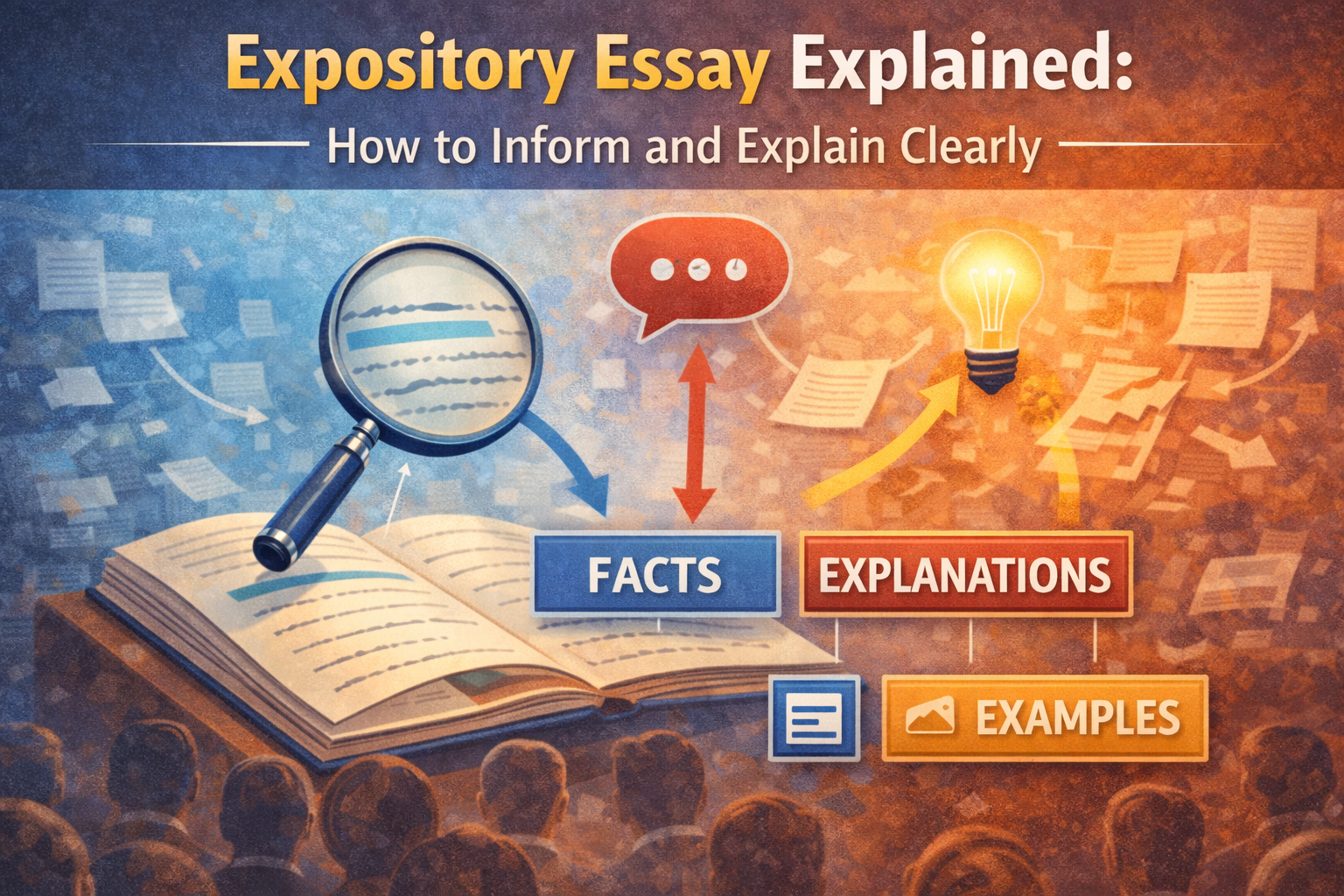
While the persuasive essay fights and the narrative essay remembers, the expository essay illuminates. Its sole purpose is to explain, inform, describe, or define a topic for the reader, using facts, statistics, and examples without the writer’s personal opinions or emotions.
Many students find this challenging because it feels “dry.” But when done well, an expository essay is a thing of beauty—a crystal-clear window into a complex subject. It’s the foundation of all academic reporting, journalism, and technical writing. Mastering it means mastering the ability to understand anything deeply and communicate that understanding with precision.
In this guide, we’ll demystify this essential format. You’ll learn to identify the five types of expository essays, structure your explanation like a pro, and present information with the authority of a museum curator: guiding the audience, letting the facts speak, and leaving them genuinely informed.
Part 1: What an Expository Essay Is (And Is NOT)
Let’s clear the confusion with a simple table:
| Expository Essay | Is NOT… |
|---|---|
| Objective & Neutral: Presents facts and evidence without taking a side. | Argumentative: It does not try to prove a debatable point. |
| Informative & Explanatory: Aims to educate the reader on a topic. | Persuasive: It does not aim to change the reader’s mind or call them to action. |
| Structured & Logical: Follows a clear organizational pattern (compare/contrast, process, etc.). | Narrative: It is not a personal story about the writer’s life. |
| Evidence-Based: Relies on credible sources, data, and examples. | Opinion-Based: The writer’s feelings (“I think,” “I believe”) are excluded. |
The Core Goal: To achieve clarity and understanding. If your reader finishes your essay and says, “I finally get it,” you’ve succeeded.
Part 2: The 5 Types of Expository Essays (Choose Your Lens)
Your approach depends on what you’re trying to explain. Think of these as five different tools for explanation.
1. The Definition Essay
- Purpose: To explain the meaning of a complex term, concept, or idea.
- Focus: Goes far beyond the dictionary. It explores the term’s history, nuances, contexts, and what it really means.
- Example Topic: What is “Social Justice”? (You’d explain its philosophical roots, key principles, and modern applications.)
2. The Process (How-To) Essay
- Purpose: To explain how something works or the steps to complete a task.
- Focus: Chronological order is key. Clear, sequential steps with necessary details and warnings about common pitfalls.
- Example Topic: How Does a Blockchain Work? or The Process of Photosynthesis.
3. The Compare and Contrast Essay
- Purpose: To examine the similarities and differences between two or more subjects.
- Focus: Can be structured Subject-by-Subject (talk all about A, then all about B) or Point-by-Point (alternate between A and B for each point of comparison).
- Example Topic: Public Schools vs. Charter Schools: Funding and Outcomes or The Political Philosophies of Hamilton and Jefferson.
4. The Cause and Effect Essay
- Purpose: To analyze the reasons (causes) for something and/or the consequences (effects) that result from it.
- Focus: Must establish clear, logical links. Avoid oversimplification (the “single cause” fallacy).
- Example Topic: The Causes of the Great Depression or The Effects of Sleep Deprivation on Adolescent Brain Development.
5. The Problem and Solution Essay
- Purpose: To analyze a problem and propose one or more viable solutions.
- Focus: Must clearly define the problem, its scope, and its significance before logically evaluating potential solutions.
- Example Topic: Addressing Plastic Pollution in the Oceans or Solutions to Urban Traffic Congestion.
Part 3: The Step-by-Step Writing Process
Step 1: Choose Your Topic and Type
Start with a subject you need or want to understand better. Then, ask: What about this do I need to explain? Your answer will point you to the type.
- Want to explain what something is? -> Definition
- Want to explain how it happens? -> Process
- Want to explain how it’s similar/different? -> Compare/Contrast
- Want to explain why it happens or what results? -> Cause/Effect
- Want to explain how to fix it? -> Problem/Solution
Step 2: Research for Understanding, Not Ammunition
Your research goal is comprehension. Gather facts, data, expert explanations, and clear examples from credible sources. Your notes should answer the “who, what, when, where, why, and how” of your topic.
Step 3: Craft a Strong Expository Thesis
Your thesis is the central explanation you will develop. It states the topic and the organizational pattern you’ll use.
- Formula: “[Topic] can be understood by [examining/defining/comparing/causing/solving] [Your Specific Angle].”
- Examples:
- (Definition) “The concept of ‘intersectionality’ can be defined by examining its origins in Black feminist thought and its application to modern social analysis.”
- (Cause/Effect) “The Renaissance was primarily caused by a convergence of increased trade, the rediscovery of classical texts, and the rise of humanist philosophy.”
- (Compare/Contrast) “While both photosynthesis and cellular respiration are essential energy processes, they can be distinguished by their inputs, outputs, and purposes within an ecosystem.”
Step 4: Structure with the “Explain This to Me” Method
Use a structure so logical that a confused reader could follow it blindfolded.
Introduction:
- Hook: Start with a surprising fact, a common misconception, or the importance of understanding this topic.
- Context: Provide necessary background.
- Thesis Statement: Your clear, explanatory thesis.
Body Paragraphs (The Explanation):
- Follow your chosen organizational pattern (process steps, causes, points of comparison, etc.).
- Each Paragraph Must Have:
- A Clear Topic Sentence: Introduces the aspect you’ll explain in this paragraph.
- Evidence & Examples: Facts, data, quotes, or concrete instances that illustrate your point.
- Analysis & Explanation: Your own words connecting the evidence to the topic sentence. This is the “explaining” part. Don’t just drop a fact; unpack it.
- Concluding Sentence: Summarizes the paragraph’s contribution to the overall explanation.
Conclusion:
- Synthesize the Explanation: Briefly recap the key points you made, showing how they fit together to form a complete picture.
- Reinforce the Significance: Why does this understanding matter? What broader context does it fit into?
- End with Insight: Offer a final, clear thought on the topic’s importance or implications.
Part 4: An Example Outline (Cause & Effect Essay)
Topic: The Rise of Remote Work
Thesis: *The widespread adoption of remote work, accelerated by the COVID-19 pandemic, has been caused by technological enablement and shifting employee values, leading to significant effects on urban geography, company culture, and work-life balance.*
I. Introduction
* Hook: Stat on % of workforce now remote.
* Context: Brief history of office-centric work.
* Thesis: (As above).
II. Body 1: Cause – Technological Enablement
* Topic Sentence: The prerequisite for remote work was the development of reliable, accessible digital infrastructure.
* Evidence: Proliferation of high-speed internet, cloud computing (Google Workspace, Slack, Zoom).
* Explanation: These tools replicated office collaboration digitally, removing the physical necessity of a central office.
III. Body 2: Cause – Shifting Employee Values
* Topic Sentence: Concurrently, a generational shift toward valuing flexibility and autonomy made remote work desirable.
* Evidence: Surveys showing priority on work-life balance over prestige; the “Great Resignation.”
* Explanation: Employees re-evaluated life priorities, with remote work offering control over time and location.
IV. Body 3: Effect – On Urban Geography & the Office
* Topic Sentence: This shift is decentralizing traditional business hubs and redefining the purpose of the office.
* Evidence: Data on declining downtown office occupancy; rise of coworking spaces in suburbs.
* Explanation: The “hub-and-spoke” model is replacing the central hub, changing real estate and commute patterns.
V. Body 4: Effect – On Company Culture & Work-Life Balance
* Topic Sentence: The effects on social cohesion and personal boundaries are complex and dual-sided.
* Evidence: Studies on both increased productivity and feelings of isolation; blurring of home/office lines.
* Explanation: Remote work offers focus and flexibility but challenges spontaneous collaboration and requires new skills in boundary-setting.
VI. Conclusion
* Synthesis: The remote work revolution was not a single event but a convergence of ready technology and changed desires, resulting in a fundamental reshaping of where and how we work.
* Significance: This represents a permanent structural change in the global economy.
* Final Thought: The ongoing challenge will be to harness the benefits of this model while intentionally rebuilding the human connections it can attenuate.
Conclusion: Become a Guide, Not a Salesman
The expository essay is an exercise in intellectual humility and clarity. It asks you to set your ego aside, delve into the facts, and build a bridge of understanding for your reader.
This skill—the ability to dissect a complex topic and reassemble it into something clear and comprehensible—is invaluable. It’s the skill of journalists, scientists, teachers, and anyone who needs to convey how the world works.
Your Next Step: Pick an everyday object or concept (a smartphone, democracy, anxiety). Now, don’t argue for or against it. Simply try to explain it in one paragraph using the Definition or Process method. Practice being a neutral guide.
Your Explanation Challenge (Comment Below!):
Let’s practice pure explanation. Choose one of the prompts below and in the comments, write:
- Which expository essay type you would use.
- A one-sentence thesis statement for that essay.
Prompts:
A. Explain what “fake news” is.
B. Explain how a vaccine teaches the body to fight disease.
C. Explain the differences between a solar eclipse and a lunar eclipse.
Example for Prompt B:
- Type: Process Essay.
- Thesis: “A vaccine works by safely introducing a模拟 of a pathogen to the immune system, thereby training it to recognize and rapidly fight the real virus in future encounters.”
I’ll provide feedback on the clarity and focus of your explanatory thesis. Let’s build those explanation muscles!
