Introduction: The Night I Learned That Writing Without an Outline is Self-Sabotage
It was 2 AM. My desk was littered with coffee cups and crumpled paper. I was on page three of a ten-page research paper, and I was hopelessly, utterly stuck. My argument had wandered into a dead-end. My paragraphs were fighting each other. The deadline loomed like a monster in the dark.
In my panic, I did the only sensible thing: I deleted everything and started over.
But this time, I didn’t start writing. I started planning. I spent 45 minutes not writing a single sentence of the paper. Instead, I sketched a map—a simple, hierarchical list of my main point, my supporting arguments, and the evidence for each. That map was my outline.
The result? I finished the remaining seven pages before sunrise, with clarity and confidence I’d never had before. The outline didn’t just organize my paper; it revealed the holes in my logic before I wasted hours writing fluff.
Let me be blunt: Skipping an outline is like trying to build an IKEA shelf without the instructions. You might have all the pieces, but you’ll waste time, get frustrated, and the final product will be wobbly.
This guide will show you a professional outlining system that works for essays, speeches, blog posts—any structured writing. I’m also giving you the exact template I use. By the end, you’ll see outlining not as an extra step, but as the ultimate time-saving, grade-boosting shortcut.
Part 1: Why Your Brain Loves an Outline (The Science of Clarity)
Writing is a two-part cognitive process:
- What to say (Content, Ideas, Arguments)
- How to say it (Phrasing, Sentences, Style)
Trying to do both at once is like juggling while solving algebra. It’s overwhelming. An outline separates these tasks. It lets you solve the hard problem of structure and logic first, in a low-pressure format. Then, writing becomes the simpler task of translating your clear plan into elegant sentences.
Benefits of a Robust Outline:
- Eliminates Writer’s Block: You’re never facing a “blank page.” You’re just filling in the next bullet point.
- Exposes Logical Gaps: If you can’t summarize a paragraph’s point in one line, the idea isn’t clear yet.
- Creates Seamless Flow: You design the transitions between ideas before you write them.
- Saves Time (Seriously): A 30-minute outline can save 3 hours of rewriting and restructuring.
Part 2: The Three-Act Outline: A Structure for Any Topic
Whether it’s 5 paragraphs or 15, every piece of persuasive or explanatory writing follows this classic narrative arc. Your outline should mirror it.
ACT I: THE INTRODUCTION (The Promise)
- Job: Hook the reader, establish context, and state your thesis.
- Outline Components:
- A. Hook: What’s your first sentence? (Question, stat, story?)
- B. Context/Narrowing: What background info does the reader need?
- C. Thesis Statement: Your one-sentence argument (from Post #6!).
ACT II: THE BODY (The Proof)
- Job: Present and prove your main points.
- Outline Components: This is broken into Roman Numerals (I, II, III), each representing one main point that supports your thesis.
- I. Main Point #1 Topic Sentence
- A. Evidence/Example: Data, quote, or case study #1.
- B. Analysis: How does this evidence prove the topic sentence?
- C. Evidence/Example #2 (if needed)
- D. Analysis for #2.
- E. Concluding/Transition Sentence: Link back to thesis.
- II. Main Point #2 Topic Sentence (Repeat structure A-E)
- III. Main Point #3 Topic Sentence (Repeat structure A-E)
- I. Main Point #1 Topic Sentence
ACT III: THE CONCLUSION (The Payoff)
- Job: Synthesize, don’t just summarize. Leave a lasting impression.
- Outline Components:
- A. Restate Thesis (in new words): How has your proof strengthened it?
- B. Summarize Key Points: Weave them together.
- C. Broader Significance / Clincher: “So what?” What’s the call to action, final thought, or look to the future?
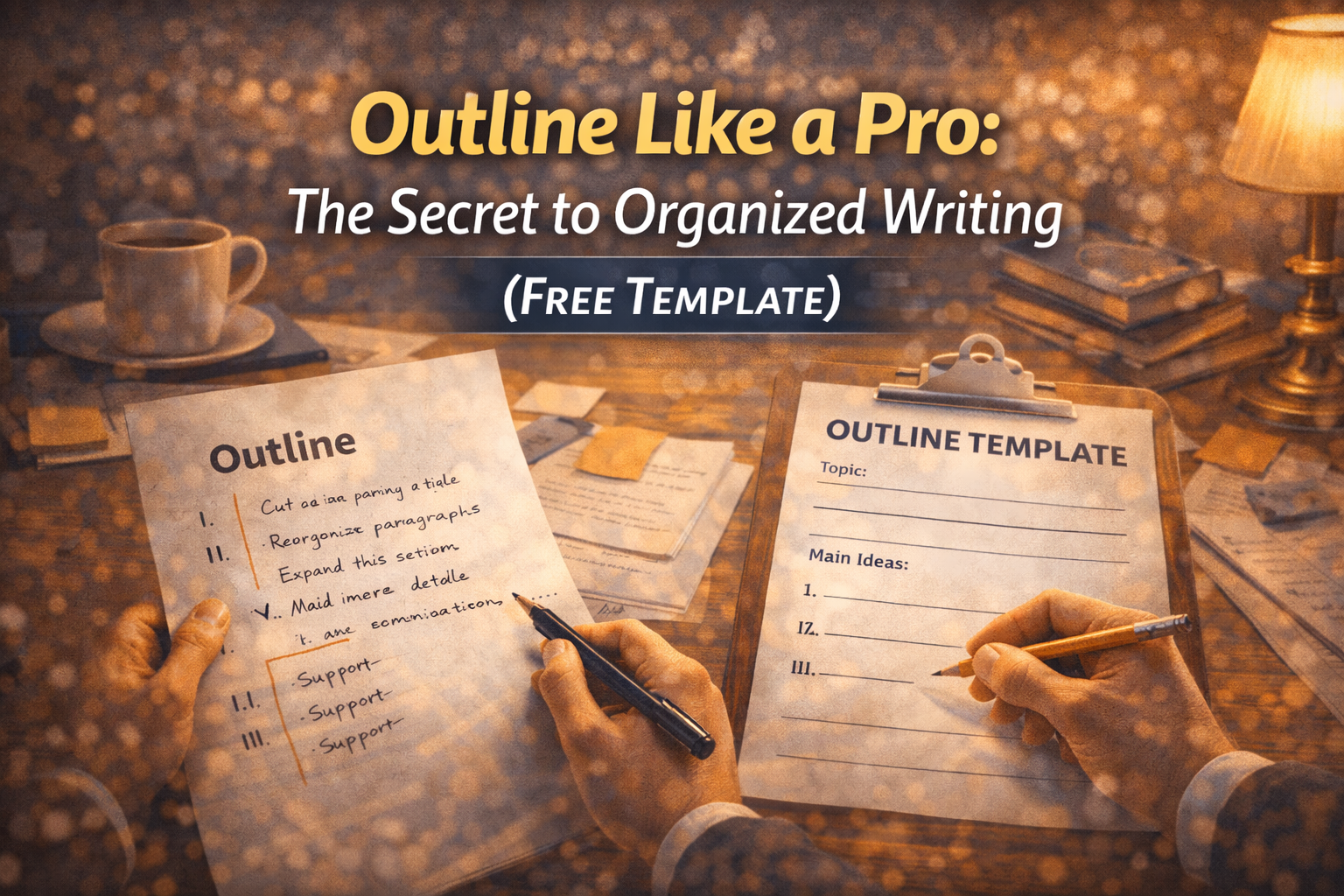
Part 3: Your Fill-in-the-Blank Outline Template
Copy this template into a document. Fill in the blanks, and you have a battle plan.
> > [DOWNLOAD THE PROFESSIONAL OUTLINE TEMPLATE (PDF/DOC)] <<
(Essay/Speech Title)
(Thesis Statement)
I. Introduction
A. Hook:
B. Context/Background (2-3 points):
1.
2.
C. Thesis Statement:
II. Body Paragraph 1: (First Main Point)
A. Topic Sentence:
B. Evidence #1: (Source: )
C. Analysis: (Explain how Evidence #1 proves Topic Sentence)
D. Evidence #2: (Source: ) Optional
E. Analysis: for Evidence #2 Optional
F. Concluding/Transition Sentence:
III. Body Paragraph 2: (Second Main Point)
A. Topic Sentence:
B. Evidence #1: (Source: )
C. Analysis:
D. Concluding/Transition Sentence:
IV. Body Paragraph 3: (Third Main Point or Counterargument)
A. Topic Sentence:
B. Evidence #1: (Source: )
C. Analysis:
D. Concluding/Transition Sentence:
V. Conclusion
A. Restate Thesis (Reframed):
B. Synthesis of Main Points:
1. (Point 1 + Point 2)
2. (Point 3 + Broader Implication)
C. Clincher/Call to Action/Final Thought:
Part 4: Outline in Action: A Real Example
Let’s apply this to a real topic using the template structure.
Topic: The Case for Later School Start Times
Working Thesis: High schools should start no earlier than 8:30 AM to improve student academic performance, mental health, and overall safety.
Filled-Out Outline:
I. Introduction
A. Hook: Imagine an entire population suffering from government-mandated jet lag. That’s the reality for millions of teenagers due to early school start times.
B. Context: Discuss the biological shift in adolescent sleep cycles (circadian rhythm delay). Mention typical 7:30 AM start times.
C. Thesis: Therefore, high schools should start no earlier than 8:30 AM to significantly improve student academic performance, mental health, and overall safety.
II. Body Paragraph 1: Academic Performance
A. Topic Sentence: Later start times directly correlate with improved academic outcomes.
B. Evidence #1: Study from University of Minnesota showing 10%+ rise in test scores in districts that shifted starts later. (Source: Sleep Research Journal)
C. Analysis: This isn’t just about more sleep; it’s about aligning the school day with peak adolescent alertness, leading to better information retention and test performance.
D. Concluding/Transition: While grades are crucial, the benefits extend beyond the transcript to students’ fundamental well-being.
III. Body Paragraph 2: Mental & Physical Health
A. Topic Sentence: Adequate sleep from later starts is a powerful intervention for teen anxiety, depression, and physical health.
B. Evidence #1: CDC data linking chronic sleep deprivation in teens to a 55% higher risk of depressive symptoms.
C. Analysis: Early starts force a choice between sleep and homework/extracurriculars, creating a chronic stress cycle that directly impacts mental health.
D. Concluding/Transition: The health benefits create a safer environment not just emotionally, but physically.
IV. Body Paragraph 3: Public Safety
A. Topic Sentence: Later starts dramatically increase community safety by reducing teen drowsy driving incidents.
B. Evidence #1: AAA Foundation report showing a 70% decrease in morning crash rates for teen drivers in districts with later starts.
C. Analysis: A sleep-deprived 16-year-old behind the wheel is a public health risk. This is a tangible, life-saving reason for change.
D. Concluding/Transition: The evidence across academic, health, and safety domains is overwhelming.
V. Conclusion
A. Restate Thesis: Moving the school bell just one hour later is a low-cost, high-impact reform proven to help students learn, thrive, and survive.
B. Synthesis: From higher GPAs and lower depression rates to safer roads, the policy aligns education with basic adolescent biology.
C. Clincher (Call to Action): It’s time for parents, educators, and school boards to prioritize scientific evidence over tradition and make student well-being the core metric of a successful schedule.
Part 5: Pro Tips for Outline Mavericks
- Start with the Body: It’s often easier to outline your main points first, then craft an intro that perfectly leads into them.
- Use Single Words or Phrases: Your outline is for you. “Stat: CDC sleep dep. → anxiety link” is perfect.
- Don’t Be a Slave to It: If you have a better idea mid-writing, adjust the outline! It’s a guide, not a prison.
- Color-Code: Use one color for evidence, another for analysis. Visually check the balance.
Conclusion: From Overwhelmed to Organized
The blank page is powerful because it’s full of potential. An outline is how you harness that potential and give it direction. It transforms the terrifying question “What do I write?” into the manageable series of prompts “What’s my hook?” “What’s my first piece of evidence?”
You are no longer just a writer. You are an architect. And every great architect works from a blueprint.
Your Next Step: For your very next assignment—big or small—commit to spending the first 20% of your time only outlining. Use the template. Experience the shocking ease of writing that follows.
Let’s Build an Outline Together (Comment Below!):
Take this simple thesis: “Reading physical books is more beneficial than reading e-books for deep comprehension and memory retention.”
In the comments, outline just ONE of its body paragraphs using the structure below:
- Topic Sentence for your chosen paragraph:
- One piece of Evidence (make it up!):
- Your Analysis (1 sentence connecting evidence to topic):
I’ll give feedback on the logical flow and strength of your outline structure. Let’s build that blueprint!
