
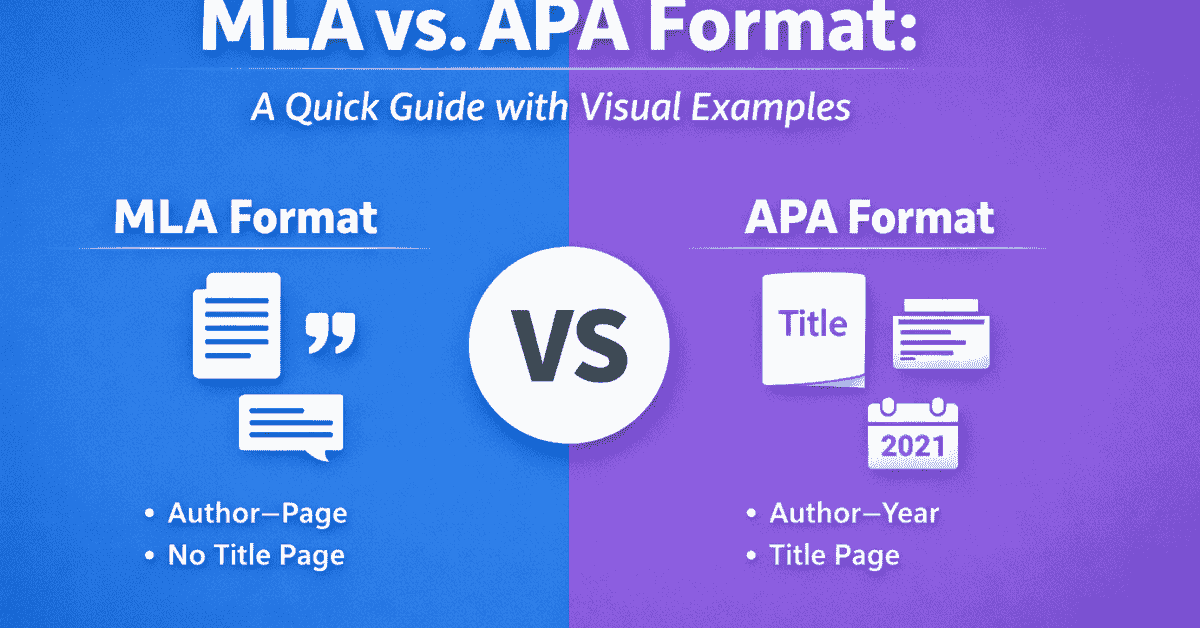
Introduction: The Formatting Freak-Out (And How to End It)
You’ve done the hard part. You’ve researched, argued, and written a brilliant paper. Now, you’re staring at the syllabus: “Format: APA 7th Edition” or “Please use MLA 9th Edition guidelines.”
A wave of dread washes over you. Is the title centered or left-aligned? Where does the page number go? Is it “References” or “Works Cited”? Is the author’s first name spelled out or abbreviated?
You are not alone. For generations of students, citation formatting has felt like a secret ritual designed to trip you up at the finish line. But here’s the liberating truth: MLA and APA are not arbitrary torture devices. They are communication tools. Their purpose is to create a uniform, clear system so that any reader can easily find and verify your sources.
Think of them as different languages for different academic conversations. MLA is the language of the humanities (literature, art, philosophy), focusing on the author and the word. APA is the language of the social sciences (psychology, education, business), focusing on the date and the replicability of research.
This guide will cut through the noise. We’ll focus on the big, common differences with clear, side-by-side visual examples. By the end, you’ll have a mental checklist to format any paper correctly, turning a source of anxiety into a simple final polish.
Part 1: The Big Picture: When to Use Which?
Use MLA (Modern Language Association) Format For:
- English, Literature, Comparative Literature
- Cultural Studies, Art History, Philosophy
- Foreign Languages, Humanities essays
Use APA (American Psychological Association) Format For:
- Psychology, Sociology, Political Science
- Education, Business, Economics
- Nursing, Social Sciences papers
The Core Philosophy Difference:
- MLA asks: “Who wrote this, and in which work can I find it?” (Author & Text are key).
- APA asks: “Who conducted this research, and when?” (Author & Date are key, because newer research is often more relevant).
Part 2: Side-by-Side Visual Guide: The First Page
This is where the differences are most visible.
Visual Example: MLA First Page (Literature Paper)
MLA 9th Edition Rules:
- Header: Your last name + page number (e.g., “Smith 1”), right-aligned on every page.
- Upper Left Corner: Your name, instructor’s name, course, date (formatted as “Day Month Year” e.g., “27 October 2023”).
- Title: Centered, standard font (no bold, underline, or quotes). Title Case.
- Text: Left-aligned, double-spaced throughout, with a 1-inch margin. Indent the first line of each paragraph 0.5 inches.
Visual Example: APA First Page (Research Report)
APA 7th Edition Rules:
- Running Head & Page Number: A shortened version of your TITLE in ALL CAPS (left-aligned) and the page number (right-aligned) on every page. On the first page only, it is preceded by the words “Running head:”.
- Title Page: Title (bolded, centered), your name, your institution (e.g., University of California). All centered and double-spaced.
- Text: Left-aligned, double-spaced, with a 1-inch margin. Indent the first line of each paragraph 0.5 inches.
Part 3: Side-by-Side: In-Text Citations
How you cite a source within your sentences.
MLA In-Text Citation
- Focus: Author + Page Number.
- Format: (Author Page).
- No comma between author and page number.
- If no page number (website), just use (Author).
Examples:
- Romantic poetry is characterized by the “spontaneous overflow of powerful feelings” (Wordsworth 263).
- The author argues that this trend is detrimental to society (Garcia).
APA In-Text Citation
- Focus: Author + Date.
- Format: (Author, Year) or (Author, Year, p. X) for a direct quote.
- Use a comma between author and date.
- Use “p.” for one page, “pp.” for multiple pages.
Examples:
- Recent studies contradict this claim (Smith, 2020).
- The survey concluded that “a majority of participants reported increased anxiety” (Lee & Chen, 2022, p. 15).
Part 4: Side-by-Side: The References Page
The final page listing all your sources.
MLA: “Works Cited” Page
- Title: “Works Cited” (centered, not bolded).
- Order: Alphabetical by author’s last name. If no author, alphabetize by title (ignore “A,” “An,” “The”).
- Hanging Indent: The first line of each entry is flush left; subsequent lines are indented 0.5 inches.
- Author Name: Last Name, First Name. (e.g., “Angelou, Maya.”).
- Containers: Key concept. The source is in a “container” (e.g., a poem is in a book, an article is in a journal, a page is on a website). You list the smaller item, then the larger container.
Example MLA Works Cited Entry (Book):
text
Angelou, Maya. I Know Why the Caged Bird Sings. Random House, 1969.
APA: “References” Page
- Title: “References” (bolded, centered).
- Order: Alphabetical by author’s last name. If no author, alphabetize by title.
- Hanging Indent: Same as MLA.
- Author Name: Last Name, First Initial. (e.g., “Smith, J. A.”).
- Date: In parentheses, right after the author(s). (Year, Month Day). For a journal, just (Year).
- Italics: Italicize titles of longer works (books, journals, websites). Do NOT italicize or use quotes for shorter works (article titles, web page titles).
Example APA References Entry (Journal Article):
text
Smith, J. A., & Chen, L. (2022). The impact of social media on adolescent sleep patterns. *Journal of Adolescent Health*, 70(4), 550-555. https://doi.org/10.1016/j.jadohealth.2021.10.012
> > [DOWNLOAD: MLA vs. APA Quick-Reference Cheat Sheet (PDF)] <<
Part 5: Common Element Comparison Chart
| Feature | MLA 9th Edition | APA 7th Edition |
|---|---|---|
| Cover Page | Not required unless specified. Info goes on first page. | Required. Title, author, institution. |
| Page Header | Last name + page # (right). | Running head (SHORT TITLE) left, page # right. |
| Title | Centered, plain text. | Centered, bolded. |
| In-Text Citation | (Author Page) – No comma. | (Author, Year, p. X) – Uses comma & “p.” |
| References List Title | Works Cited (centered). | References (centered, bold). |
| Author Name | Wordsworth, William. | Wordsworth, W. |
| Source Title (Book) | Italicized. | Italicized. |
| Article/Chapter Title | In “quotation marks”. | Plain text, no quotes. Sentence case. |
| Date | Near end of entry, full date if available. | Right after author, (Year). |
| URLs/DOIs | Include full URL (no “https://”). No period at end. | Include DOI as a hyperlink if available. Use a period at the end. |
Part 6: Pro-Tips to Never Get It Wrong
- Use a Citation Generator… Wisely: Tools like ZoteroBib, MyBib, or the one in Word/Google Docs are great starting points. BUT, always double-check their output against an official guide. They often make subtle errors.
- Find a Model Paper: Search for “[Your School] Library APA sample paper” or “Purdue OWL MLA sample paper.” Format yours to match, element by element.
- The “Look It Up” Shortcut: Bookmark the Purdue Online Writing Lab (OWL). It’s the free, gold-standard resource for both MLA and APA. When in doubt, OWL it out.
- Consistency is King: It’s better to be consistently slightly wrong (and lose a point) than to be haphazard (which looks careless). Pick one style guide and stick to its rules throughout.
Conclusion: Formatting is the Suit Your Paper Wears
A well-formatted paper is like wearing the right outfit to an event. It shows respect for the occasion (academia), makes you look put-together (credible), and ensures people focus on what you’re saying (your ideas), not what you’re wearing (sloppy formatting).
Don’t let the ritual overshadow the reason. These formats exist to serve clarity and credibility. Learn the basic rules, use your tools, and then direct your energy back to what matters most: your analysis, your argument, your voice.
Your Next Step: Open your most recent paper. Even if it’s already graded, try reformatting it from MLA to APA or vice-versa as an exercise. This hands-on practice is the fastest way to learn the differences.
Your Formatting Clinic (Comment Below!):
Let’s practice the most common task: creating a citation entry.
Take this source information:
- Author: Naomi Klein
- Book Title: This Changes Everything: Capitalism vs. The Climate
- Publisher: Simon & Schuster
- Year: 2014
In the comments:
- Write the MLA 9th Edition Works Cited entry.
- Write the APA 7th Edition References entry.
I’ll check your work and provide feedback. Let’s nail those citations!
