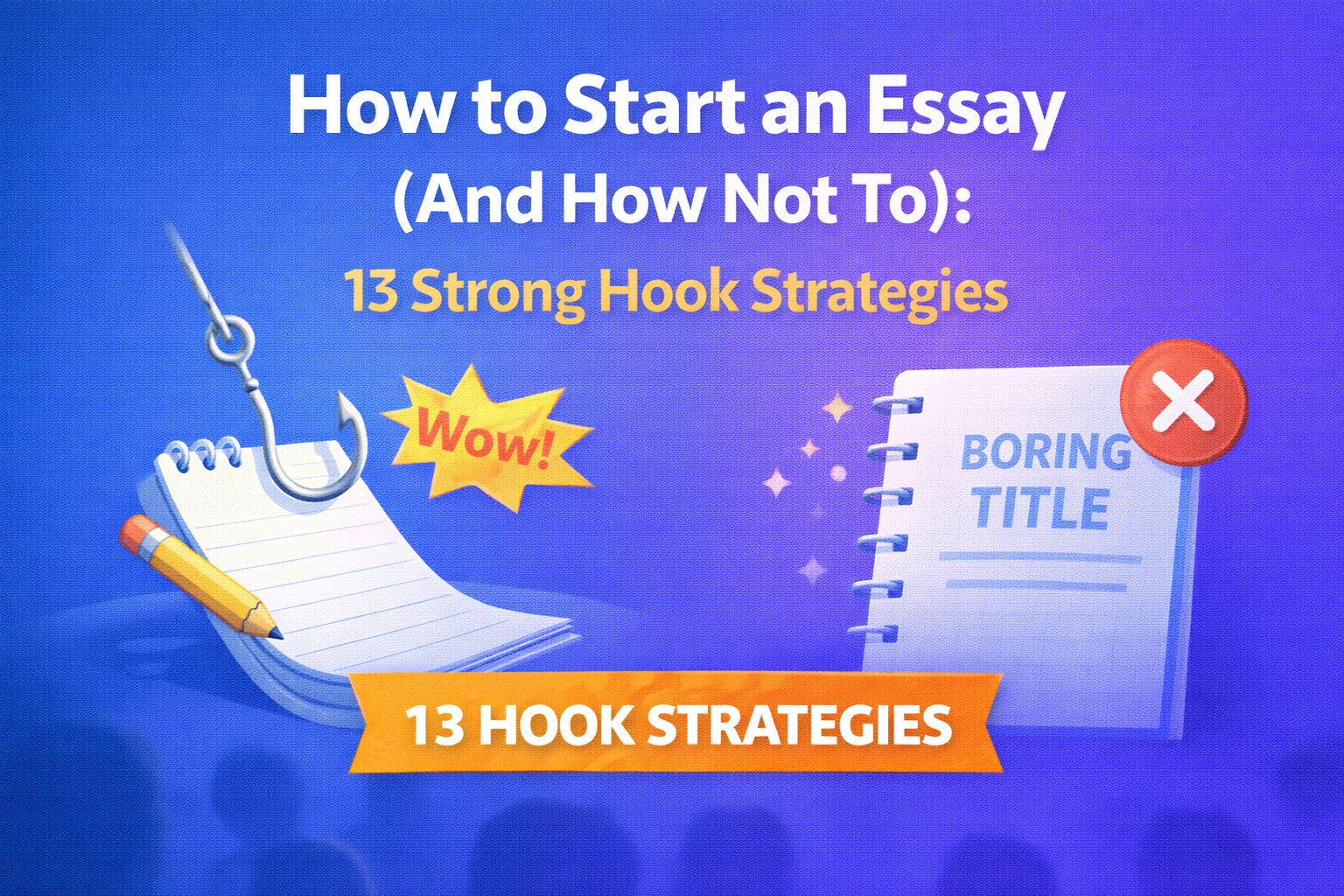
Introduction: The 5-Second Rule That Determines Your Essay’s Fate
Your reader—whether a professor grading 50 papers, an admissions officer skimming thousands, or a casual browser—will decide if your essay is worth their time in the first five seconds.
That’s all you get. One opening sentence. One chance to hook their attention before their mind wanders to the next task.
A weak opening is like mumbling hello at a party—you become background noise. A strong opening is a firm handshake, direct eye contact, and a compelling question that makes the listener lean in and say, “Tell me more.”
I’ve read countless essays that die in the first line with a yawn-inducing, “Throughout history…” or “In today’s society…” These openings broadcast one message: I am writing an obligatory essay, and I have nothing original to say.
But you do. You just need the right tool to crack it open.
This guide delivers 13 proven hook strategies, complete with “How-To” and “What to Avoid” advice. We’ll cover everything from startling statistics to evocative scenes. By the end, you’ll have a toolkit to ensure your first sentence isn’t a stumbling block, but a springboard into your best work.
Part 1: The 3 Opening Killers (Avoid These at All Costs)
Before we build, let’s demolish the weak foundations. Never start with:
- The Dictionary Definition: “Webster’s defines ‘courage’ as…” (This is the hallmark of a student who has no original entry point.)
- The Vague Proclamation: “Throughout human history, people have debated freedom.” (Too broad, too impersonal, too boring.)
- The Book Report: “In the novel To Kill a Mockingbird by Harper Lee, the theme of racism is explored.” (Your professor assigned the book. They know. Just begin your analysis.)
These openings delay your real argument and signal a lack of creativity. Now, let’s replace them with something powerful.
Part 2: The 13 Hook Strategies (With Examples)
Category 1: The “Intrigue” Hooks
1. The Startling Statistic
Use a hard number to shatter assumptions and create urgency.
- How-To: Find a fresh, relevant, and credible statistic. Frame it powerfully.
- Example: “Every 2.5 seconds, a football field’s worth of mature rainforest is destroyed. This isn’t just an environmental tragedy; it’s a microbial apocalypse we’re causing blind.”
- Avoid: Using an overused stat or failing to explain its significance.
2. The Provocative Question
Ask a question that challenges a common belief or introduces a paradox.
- How-To: Make it a question without a simple yes/no answer. It should set up the problem your essay will solve.
- Example: “What if everything you’ve been told about procrastination is wrong? What if it’s not a character flaw, but a sophisticated—if often dysfunctional—emotional management system?”
- Avoid: Rhetorical questions that are obvious or cliché (“Have you ever wondered about love?”).
3. The Bold Declaration
State a strong, arguable opinion upfront.
- How-To: Lead with your thesis’s core sentiment in its most distilled, confident form.
- Example: “Standardized testing is not a measure of student potential; it is a multi-billion-dollar industry that measures a student’s economic background and their ability to endure boredom.”
- Avoid: Making a declaration that is offensive or impossible to support.
Category 2: The “Story” Hooks
4. The Vivid Scene (Anecdote)
Drop your reader into a specific moment. Use sensory details.
- How-To: Zoom in. Describe a 30-second moment that encapsulates your larger theme.
- Example: “The only sound in the surgical gallery was the steady beep of the heart monitor and the rustle of my gown as I shifted my weight. My mentor’s hands, gloved in blue, were perfectly still—a poised contradiction to the chaotic symphony of blood vessels he was about to navigate.”
- Avoid: A long, rambling story unrelated to your thesis. Keep it under 3 sentences.
5. The Historical Moment
Begin with a pivotal, lesser-known historical event that parallels your topic.
- How-To: Find a moment that is dramatic and directly illustrative.
- Example: “On October 30, 1938, panic swept America as thousands believed Martians were invading. Orson Welles’ radio play succeeded not because people were gullible, but because it exploited the profound anxiety of a nation on the brink of war—a lesson in media manipulation that feels unnervingly familiar today.”
- Avoid: The overly familiar (“When Columbus sailed in 1492…”).
6. The Personal Revelation
Share a brief, authentic moment of personal change or understanding.
- How-To: Be specific and humble. Focus on the shift in thinking.
- Example: “I spent the first 15 years of my life carefully constructing a personality I thought was impressive. It took my little brother, who has nonverbal autism, grabbing my hand and leading me to his favorite rock to show me that the most profound connections require no performance at all.”
- Avoid: Oversharing or melodrama. The focus should be on the insight, not the trauma.
Category 3: The “Conceptual” Hooks
7. The Powerful Quote
Use a short, potent quote from a figure relevant to your topic.
- How-To: Don’t just drop the quote. Weave it into your own sentence and immediately comment on it.
- Example: “When Seneca wrote, ‘We suffer more often in imagination than in reality,’ he identified the core engine of modern anxiety—a mechanism now amplified by the endless ‘what-if’ simulations run by our digital feeds.”
- Avoid: The overused (e.g., “Be the change…” without fresh context) or long block quotes.
8. The Misconception
Identify and immediately correct a common error in thinking.
- How-To: State what “many people believe,” then pivot with “But the truth is…”
- Example: “Most people think of silence as the absence of sound. For neuroscientists, however, silence is an active state for the brain—a crucial nutrient for cognition that our world is starving us of.”
- Avoid: Setting up a strawman argument (a fake misconception no one actually holds).
9. The Analogy or Metaphor
Explain your complex topic by comparing it to something familiar and vivid.
- How-To: The analogy must be clean, insightful, and sustained enough to illuminate.
- Example: “A nation’s infrastructure is its circulatory system. When roads, bridges, and grids age and fail, it’s not mere inconvenience; it’s a slow-moving stroke, paralyzing the economic and social body from the inside out.”
- Avoid: Mixed metaphors or clichéd comparisons (e.g., “life is a journey”).
Category 4: The “Dialogue” Hooks
10. The Dialogue or Quotation
Start with a line of spoken words (real or representative).
- How-To: Use a short, punchy exchange or statement that reveals character or conflict.
- Example: “‘You’re not like other girls.’ For years, I wore that backhanded compliment as a badge of honor. It took me a decade to unpack the misogyny buried in those five words—the suggestion that solidarity with my own gender was a flaw.”
- Avoid: Long, confusing dialogue without context.
Category 5: The “Descriptive” Hooks
11. The Striking Contrast (Juxtaposition)
Place two opposing ideas or images side-by-side to create tension.
- How-To: Use parallel structure to highlight the contradiction.
- Example: “We live in the most connected age in human history, and yet epidemiologists now warn of a ‘loneliness epidemic’ as deadly as smoking. This paradox lies at the heart of our digital dilemma.”
- Avoid: Contrasts that are illogical or forced.
12. The Evocative Description
Paint a picture of a place, object, or feeling that embodies your theme.
- How-To: Engage the senses. Describe what is seen, heard, felt.
- Example: “The abandoned factory wasn’t just rust and broken glass. It was the smell of old oil and damp concrete, the sigh of wind through shattered windows—a monument not to industry, but to its absence.”
- Avoid: Purple prose (overly flowery language) that doesn’t serve a point.
13. The “Imagine” Scenario
Invite the reader to visualize a hypothetical situation.
- How-To: Make the scenario concrete and relevant. Use it to illustrate a problem or possibility.
- Example: “Imagine a currency that isn’t controlled by any government, that can be sent anywhere in the world in minutes, and whose ledger is public and unchangeable. This isn’t future speculation; it’s the basic premise of Bitcoin, and it’s challenging five centuries of financial tradition.”
- Avoid: Scenarios that are too fanciful or irrelevant to your academic argument.
Part 3: The Golden Rule: Connect Your Hook to Your Thesis
A hook is useless if it’s an island. Your second sentence must bridge it to your core argument.
- Weak: [Startling Stat about plastic pollution]… “This essay will discuss ocean pollution.”
- Strong: [Startling Stat about plastic pollution]… “This relentless tide of waste points to a fundamental flaw in our ‘disposable’ economy, necessitating a systemic shift toward circular design principles that this paper will advocate for.”
The bridge sentence is where you contextualize the hook and smoothly pivot to your thesis statement.
Conclusion: Your First Sentence is a Promise
Your opening line is a promise to the reader about the journey ahead. A startling statistic promises a data-driven analysis. A vivid scene promises a narrative exploration. A bold declaration promises a rigorous argument.
Choose the promise that fits your essay’s purpose. Then, deliver on it with every sentence that follows.
Your Next Step: Look at your current essay draft. Delete your first sentence. Now, try writing three different opening hooks for it (e.g., one statistic, one question, one scene). Which one feels most alive? Which one most accurately promises what’s to come? Use that one.
Your Hook Workshop (Comment Below!):
Let’s practice. Pick one of the following essay topics and try two different hooks from the list above.
Topics:
- The importance of failure in learning.
- The impact of social media on political discourse.
- Why a particular book should be required reading.
In the comments, post:
- Your chosen topic.
- Hook #1 (with strategy name, e.g., “Bold Declaration”).
- Hook #2 (with a different strategy name).
Example for Topic #1:
- Topic: Failure in learning.
- Hook 1 (Misconception): “Our education system treats failure as a bug in the software of learning. What if it’s actually a key feature?”
- Hook 2 (Personal Revelation): “My most valuable grade was the ‘F’ scrawled in red on my first robotics prototype; it wasn’t an end, but a detailed map of what to rebuild.”
I’ll give feedback on which is stronger and why. Let’s craft some irresistible openings!
