Introduction: Why Your First Draft is (Supposed to Be) a Disaster
Here’s a liberating secret from a professional writer: My first drafts are terrible. They’re messy, disjointed, and full of awkward phrases. And that’s exactly how they should be.
The magic—the art—doesn’t happen in the first draft. It happens in the rewrite. The problem is, most people try to fix everything at once. They’ll write a sentence, backspace to fix a typo, re-read a paragraph, change a word, and wonder why they’ve been staring at the screen for an hour with only three sentences to show for it.
This approach is like trying to sculpt the fine details of a statue while the block of marble is still a rough, unshaped rock. It’s futile and frustrating.
The solution is to separate creation from correction. To understand that revising and editing are two distinct, sequential processes. Mastering this two-step system is what separates an amateur draft from a professional final piece. Today, I’ll give you a clear, actionable framework to polish anything you write with confidence and efficiency.
Part 1: The Critical Difference (Don’t Mix These Up!)
Think of writing like building a house.
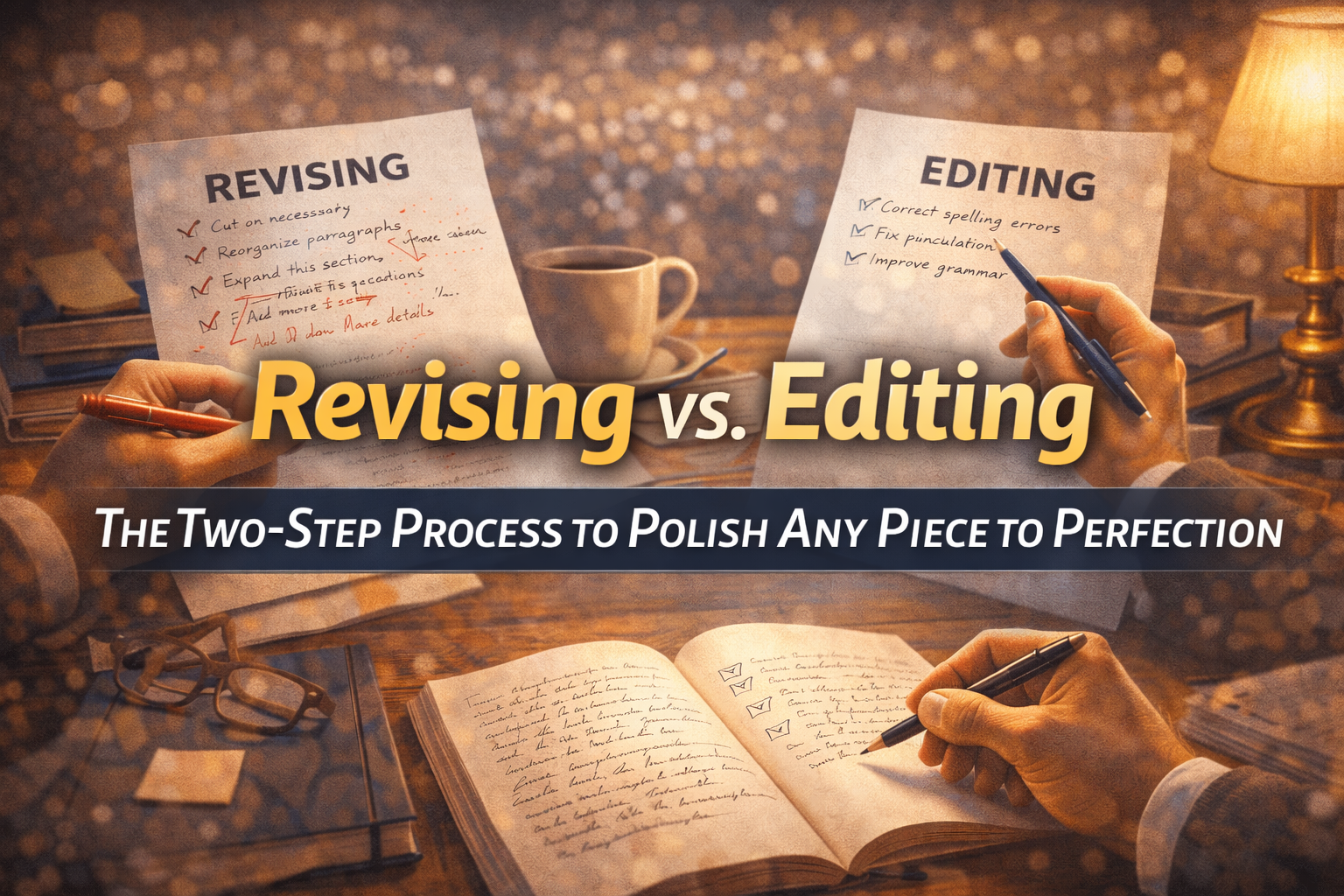
- Revising is about ARCHITECTURE. You step back. Is the foundation solid? Are the rooms in the right order? Do we need to move a wall or add a window? You’re working on the macro level: argument, structure, and flow.
- Editing is about INTERIOR DESIGN. Now the structure is sound. You’re painting walls, hanging art, and making sure every light switch works. You’re working on the micro level: words, sentences, and grammar.
Doing both at once is chaos. You can’t pick the perfect paint color if you’re still deciding whether to put the wall there. Let’s break down each step.
Step 1: The Revising Stage — Be a Ruthless Architect
Your goal here is to look at the Big Picture. Forget spelling. Ignore commas. We are judging the piece on three pillars: Argument, Structure, and Clarity.
The Golden Rule of Revising: Let your draft COLD. After you finish your first draft, get away from it. Take a walk, sleep on it, work on something else for at least an hour. This distance is essential to see what you actually wrote, not what you meant to write.
The Revising Checklist: Ask These “Big Picture” Questions
A. Argument & Content:
- ✅ Thesis Focus: Does every paragraph directly support or prove my main thesis? Have I strayed?
- ✅ Strength of Evidence: Are my examples, data, and quotes the strongest possible ones? Are there any logical leaps or unsupported claims?
- ✅ Counterarguments: Have I addressed the most obvious objection to my point? Does my argument feel complete?
- ✅ “So What?” Factor: Is the significance of my argument clear? Why should the reader care?
B. Structure & Flow:
- ✅ Logical Order: Do my points build on each other in the most persuasive or understandable sequence? Should I move any sections?
- ✅ Paragraph Unity: Does each paragraph have one clear main idea (in the topic sentence)? Are there any paragraphs that try to do too much and need to be split?
- ✅ Effective Transitions: Do I guide the reader smoothly from one idea to the next? Do sentences and paragraphs connect, or do they just jump?
- ✅ Introduction & Conclusion: Does my intro hook the reader and accurately preview what’s coming? Does my conclusion powerfully synthesize my points without just repeating them?
C. Clarity & Style (Macro):
- ✅ Wordiness: Can I say this more simply? Look for phrases like “due to the fact that” (use “because”) or “in order to” (use “to”).
- ✅ Passive Voice: Have I used passive voice (“the ball was thrown”) where active voice (“she threw the ball”) would be stronger and clearer?
- ✅ Tone & Audience: Is my tone consistent and appropriate for my audience (formal, conversational, persuasive)?
How to Execute Revisions:
- Print it out. Work on paper with a pen. It changes your perspective.
- Read it ALOUD. Your ear will catch clunky phrasing and awkward transitions your eye will skip over.
- Use the “Reverse Outline”: After your draft is done, write a new outline based on what you actually wrote. Does it match your original plan? Where did it diverge? This exposes structural flaws instantly.
The Outcome of Revision: A transformed draft. Whole sections may be rearranged, paragraphs added or deleted, arguments strengthened. The core message is now rock-solid.
Step 2: The Editing Stage — Be a Meticulous Designer
Now, and only now, do we worry about the details. Your piece is architecturally sound. Your job is to make every sentence shine and ensure zero technical errors.
The Editing Checklist: Line-by-Line Perfection
D. Sentence-Level Craft:
- ✅ Sentence Variety: Do my sentences all have the same length and structure? Mix short, punchy sentences with longer, more complex ones for rhythm.
- ✅ Precise Language: Have I used vague words (“good,” “bad,” “thing”) where specific, powerful words would be better?
- ✅ Strong Verbs: Have I buried my verbs in “nounizations” (e.g., “made an assumption” vs. “assumed”)? Hunt for “is,” “are,” “was,” “were” and see if you can use a more action-oriented verb.
E. Grammar & Mechanics:
- ✅ Spelling: Don’t just trust the squiggly red line. Read backwards to catch typos.
- ✅ Punctuation: Pay special attention to comma usage, apostrophes, and semicolons.
- ✅ Subject-Verb Agreement & Tense Consistency: Is everything in the correct tense? Do singular subjects have singular verbs?
- ✅ Citations & Formatting: Are all quotes and ideas properly cited? Is the formatting (MLA, APA, font, margins) perfect?
How to Execute Editing:
- Use Tools, But Don’t Trust Them Blindly: Run spellcheck and grammar check (Grammarly, etc.), but understand why a suggestion is made. The tool is often wrong about context and tone.
- Edit in Passes: Try one pass just for comma errors. Another just for word repetition. Breaking it down makes it less overwhelming.
- Get a Second Pair of Eyes: If possible, have a friend read it. They will catch errors you’ve become blind to.
The Outcome of Editing: A polished, professional, publication-ready piece. It’s clear, correct, and a pleasure to read.
Part 3: A Side-by-Side Example: From Draft to Revised to Edited
First Draft Sentence (Messy but has an idea):
“The author’s way of writing about the setting kinda makes you feel like the character is all alone and cut off from the world, which is a metaphor for her, you know, mental state at that point in time.”
After REVISION (Fixes argument, structure, clarity):
“The author’s use of desolate imagery in the setting—the “empty moor,” the “howling wind”—creates a powerful external reflection of the protagonist’s profound isolation and psychological turmoil.”
After EDITING (Fixes grammar, word choice, precision):
“The author’s desolate imagery—the “empty moor,” the “howling wind”—creates an external landscape that mirrors the protagonist’s isolation and psychological turmoil.”
See the progression? Revision shaped the thought into an argument. Editing sharpened the language.
Part 4: Your Ultimate Polishing Checklist
Print this and use it for every single piece you write.
REVISING CHECKLIST (The Big Picture)
- My thesis is clear and arguable.
- Every paragraph supports the thesis.
- My evidence is strong and relevant.
- The order of points is logical.
- Transitions guide the reader.
- The intro hooks and the conclusion resonates.
- I’ve addressed obvious counterarguments.
- No sections are wordy or vague.
EDITING CHECKLIST (The Details)
- Sentences vary in length and structure.
- I use strong, active verbs.
- Spelling is correct (beyond auto-correct).
- Commas and apostrophes are used properly.
- There are no grammar errors (tense, agreement).
- All sources are correctly cited.
- Formatting meets requirements.
Conclusion: Polish with Purpose
Writing is rewriting. By separating the creative, structural work of revision from the precise, technical work of editing, you take control of the process. You move from being overwhelmed by a “bad” draft to being empowered by a clear, two-stage mission.
Your first draft’s only job is to exist. Your revision’s job is to make it brilliant. Your edit’s job is to make it flawless.
Your Next Step: Open your most recent draft. Don’t look for typos. Use only the Revising Checklist from above. Make the big, brave changes it needs. Then, and only then, run the editing pass.
Your Polishing Challenge (Comment Below!):
Take this messy first-draft paragraph and practice REVISING it (focus on argument and clarity, not grammar):
“Social media. It has good and bad points. A good point is you can talk to friends and find out news. A bad thing is it can be fake and people can be mean. It makes people compare their lives. This can be not good for how they feel about themselves.”
In the comments, post your revised version. Show how you’d strengthen the argument and clarify the ideas. I’ll provide feedback on your revision skills!
