Introduction: The Invisible Architecture of Great Writing
Read these two paragraphs:
“I love living in the city. There’s always something to do. The noise and crowds get overwhelming. I sometimes dream of moving to the countryside.”
Now read this version:
“I love living in the city because there’s always something to do. However, the noise and crowds get overwhelming. As a result, I sometimes dream of moving to the countryside.”
See the difference? The second version doesn’t just present ideas—it shows the relationship between them. The magic glue that transforms a list of statements into a coherent, persuasive argument is transition words.
Yet, most writers only use “however,” “therefore,” and “also” on repeat. It’s like building a skyscraper with only three types of bolts. Your structure holds, but it’s clunky and limited.
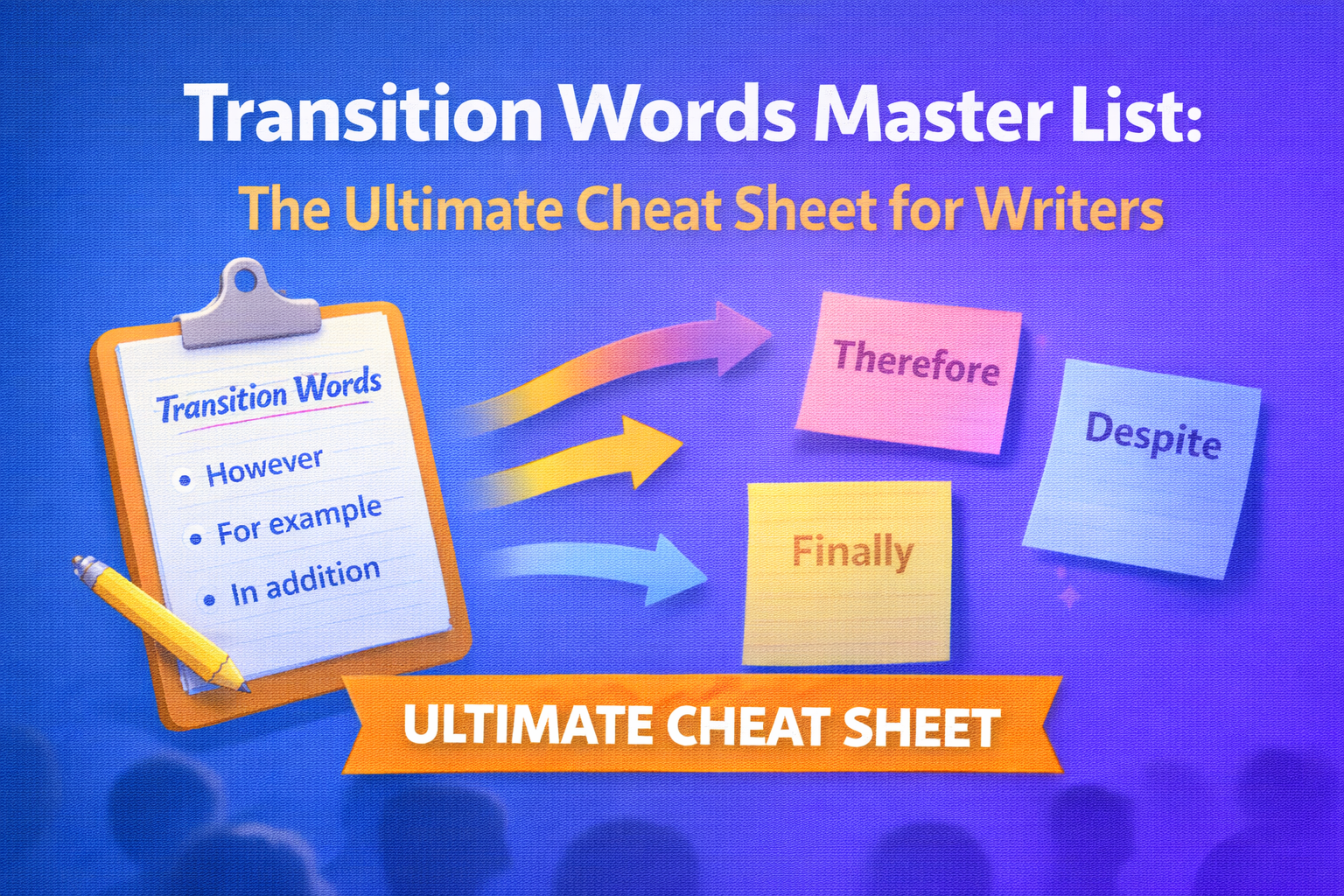
This guide is your complete hardware store. I’ve organized every essential transition word and phrase by its logical function, complete with real examples. This isn’t just a list to memorize; it’s a toolkit to master. By the end, you’ll be able to guide your reader through complex arguments with the precision of a tour guide, making your essays, reports, and stories not just readable, but effortlessly compelling.
Part 1: What Are Transitions and Why Do They Matter?
Transitions are words, phrases, or sentences that connect ideas, sentences, and paragraphs. They act as bridges, signaling to your reader how one idea relates to the next.
Why they’re non-negotiable:
- They Create Flow: They prevent your writing from sounding like a choppy list.
- They Enhance Logic: They make your argument’s structure visible (e.g., “This leads to… which proves that…”).
- They Improve Readability: They help readers follow your train of thought without getting lost.
- They Demonstrate Sophistication: Proper use shows command of language and logical reasoning (key for high grades and professional writing).
Part 2: The Master Cheat Sheet (Organized by Function)
Think of these as the different types of bridges you can build between ideas.
Category 1: To ADD or SHOW SIMILARITY (The “And” Family)
Use these when you’re adding a supporting point, another example, or a similar idea.
- Basic Addition: and, also, too, in addition, furthermore, moreover, besides, not only… but also
- Introducing Examples: for example, for instance, to illustrate, specifically, in particular, namely
- Showing Similarity: similarly, likewise, in the same way, by the same token, correspondingly
Examples:
“The theory is economically sound. Furthermore, it is supported by recent sociological data.”
“The city must address several issues, namely traffic congestion, housing affordability, and waste management.”
“Just as a strong foundation is vital for a building, a clear thesis is crucial for an essay.”
Category 2: To CONTRAST or SHOW DIFFERENCE (The “But” Family)
Use these to introduce an opposing view, a limitation, or an unexpected result.
- Direct Opposition: but, yet, however, nevertheless, on the other hand, in contrast, conversely, on the contrary
- Concession (Acknowledging a point): although, even though, despite, in spite of, granted, while it is true that, admittedly
- Unexpected Result: however, nevertheless, nonetheless, still, even so
Examples:
“The initial results were promising. However, the long-term data told a different story.”
“Despite the clear financial benefits, the committee voted against the proposal.”
“The novel is set in a fantasy world; nevertheless, its themes are deeply relevant to modern society.”
Category 3: To Show CAUSE, REASON, or RESULT (The “So” Family)
Use these to show why something happened (cause) or what happened as a consequence (effect).
- Cause/Reason: because, since, as, for, due to, owing to, in light of
- Effect/Result: therefore, thus, consequently, as a result, hence, accordingly, for this reason, so
Examples:
“Due to the sudden storm, the outdoor event was canceled.”
“The study was methodologically flawed. Consequently, its conclusions are unreliable.”
“Since we have exhausted all other options, surgery is the recommended course.”
Category 4: To Show TIME, ORDER, or SEQUENCE (The “Then” Family)
Use these to narrate events, describe a process, or structure an argument in steps.
- Beginning/First: first, firstly, initially, to begin with, in the first place
- Continuing/Next: second, secondly, next, then, subsequently, after that, later, meanwhile
- Ending/Finally: finally, lastly, ultimately, in conclusion, to conclude
Examples:
“To begin with, we must define our key terms. Next, we will examine the historical context.”
“The protagonist receives the call to adventure. Subsequently, she refuses it before finally accepting.”
“Finally, the author returns to the opening metaphor, creating a powerful sense of closure.”
Category 5: To EMPHASIZE or CLARIFY (The “In fact” Family)
Use these to drive a point home, add emphasis, or rephrase for clarity.
- Emphasis: indeed, in fact, as a matter of fact, certainly, undoubtedly, without a doubt
- Clarification/Explanation: that is, in other words, to put it another way, to clarify, namely
Examples:
“The data is not merely suggestive; in fact, it is conclusive.”
“The policy is regressive—that is, it disproportionately harms the most vulnerable.”
“Certainly, there are valid concerns, but the benefits outweigh them.”
Category 6: To Show PLACE or DIRECTION (The “Where” Family)
Use these primarily in descriptive or narrative writing to orient the reader.
- Place/Direction: above, below, beyond, nearby, adjacent to, opposite to, here, there
Examples:
“The castle stood on the hill. Below, the village slept in the valley.”
“Adjacent to the main argument, the author makes a crucial side point.”
Category 7: To SUMMARIZE or CONCLUDE (The “In summary” Family)
Use these in your concluding paragraphs or to wrap up a complex section.
- To Summarize/Conclude: in summary, to summarize, in conclusion, to conclude, in short, in brief, overall, ultimately
Examples:
“In short, the experiment failed to replicate the original findings.”
“Overall, the evidence points strongly toward a need for policy reform.”
Part 3: How to Use Transitions Like a Pro (Beyond the List)
Knowing the words is step one. Using them effectively is step two.
Rule 1: Don’t Overdo It
Not every sentence needs a transition. If the logical connection is already obvious, forcing one in sounds awkward and amateurish.
- Awkward: “I woke up. Then I brushed my teeth. After that, I ate breakfast.”
- Better: “I woke up, brushed my teeth, and ate breakfast.”
Rule 2: Vary Your Choices
Using “however” five times in one page screams limited vocabulary. Use the cheat sheet to find synonyms that fit the context.
Rule 3: Pay Attention to Punctuation
- However, Therefore, Furthermore (at the start of a sentence): Usually followed by a comma.
- “However, we decided to proceed.”
- However / Therefore (in the middle of a sentence): Often set off by commas.
- “We decided, however, to proceed.”
- And / But / So / Yet (joining two independent clauses): Use a comma before them.
- “The data was compelling, so we changed our hypothesis.”
Rule 4: Use Paragraph Transitions
The first sentence of a new paragraph is prime real estate for a transition. Use it to link back to the previous paragraph’s idea.
- “Given this financial burden, many students are forced to work full-time while studying.”
- “A similar pattern emerges when we examine the demographic data.”
Part 4: Before-and-After Examples
Choppy, Immature Writing:
“Social media connects people. It can lead to isolation. People compare their lives to others. This causes anxiety. Social media has benefits.”
With Strategic Transitions (Mature & Coherent):
“While social media undoubtedly connects people, it can also lead to feelings of isolation. This is because users often compare their own lives to the curated highlights of others, which can cause significant anxiety. Nevertheless, it is important to acknowledge that social media has genuine benefits when used mindfully.”
See how the transitions (“While,” “also,” “This is because,” “which,” “Nevertheless”) create a mini-argument with nuance and flow?
Conclusion: Your Writing’s Secret Weapon
Transitions are the silent workhorses of powerful prose. They don’t just decorate your sentences; they build the intellectual scaffolding that allows your ideas to stand tall and connect.
Don’t leave them to chance. Bookmark this guide. Print the cheat sheet. Before you finalize any piece of writing, do a “transition pass.” Scan your paragraphs and ask: “How does this idea connect to the next one?” If the connection isn’t crystal clear, deploy the right word from your toolkit.
Your Next Step: Take a paragraph from an old essay or report. Circle every transition. Now, use the cheat sheet to replace at least one with a more precise or varied alternative. Feel the immediate upgrade in flow and professionalism.
Your Transition Upgrade Challenge (Comment Below!):
Let’s practice. I’ll give you a choppy pair of sentences. Your job is to combine them into one smooth sentence using an appropriate transition from the cheat sheet.
Sentence 1: The company’s profits soared last quarter.
Sentence 2: Employee morale reached an all-time low.
In the comments:
- Write your new, combined sentence.
- Name the category of transition you used (e.g., Contrast, Cause/Effect).
Example: “Although the company’s profits soared last quarter, employee morale reached an all-time low.” (Category: Contrast)
I’ll provide feedback and show you other clever ways to connect them. Let’s build those bridges!
