
Introduction: Why We Still Listen to Speeches Given Before We Were Born
A great speech is a time machine. It can transport us to a pivotal moment, make us feel the collective hope or fear of a generation, and implant ideas that outlive the speaker by centuries. But in an age of 280-character tweets and 60-second videos, why do we still study speeches delivered 50, 100, or 2,000 years ago?
Because the mechanics of human persuasion and inspiration haven’t changed. The same techniques that moved a crowd in ancient Rome or wartime London work in a classroom, a boardroom, or a wedding hall today.
You don’t need a world war or a presidency to use them. You just need to understand the blueprint of power hidden within the words.
In this guide, we’ll dissect over ten of history’s most famous short speeches. We won’t just summarize them; we’ll reverse-engineer them. We’ll highlight the specific rhetorical devices, structural choices, and delivery tricks that transformed words into weapons, comfort, and catalysts. By the end, you’ll have a toolkit of classic techniques to make your own speeches—big or small—resonate with timeless power.
Part 1: The Analysis Framework – What to Listen For
When you listen to a great speech, ask these questions:
- The Hook: How does it grab attention immediately?
- The Core Message: What is the single, unforgettable idea?
- The Structure: How does it build logically or emotionally?
- Rhetorical Devices: What patterns of language are used (repetition, triples, contrasts)?
- Audience Connection: How does the speaker make them feel seen and essential to the story?
- The Clincher: How does it end? What’s the final feeling or call?
Let’s apply this framework.
Part 2: The Speeches & Their Secret Weapons
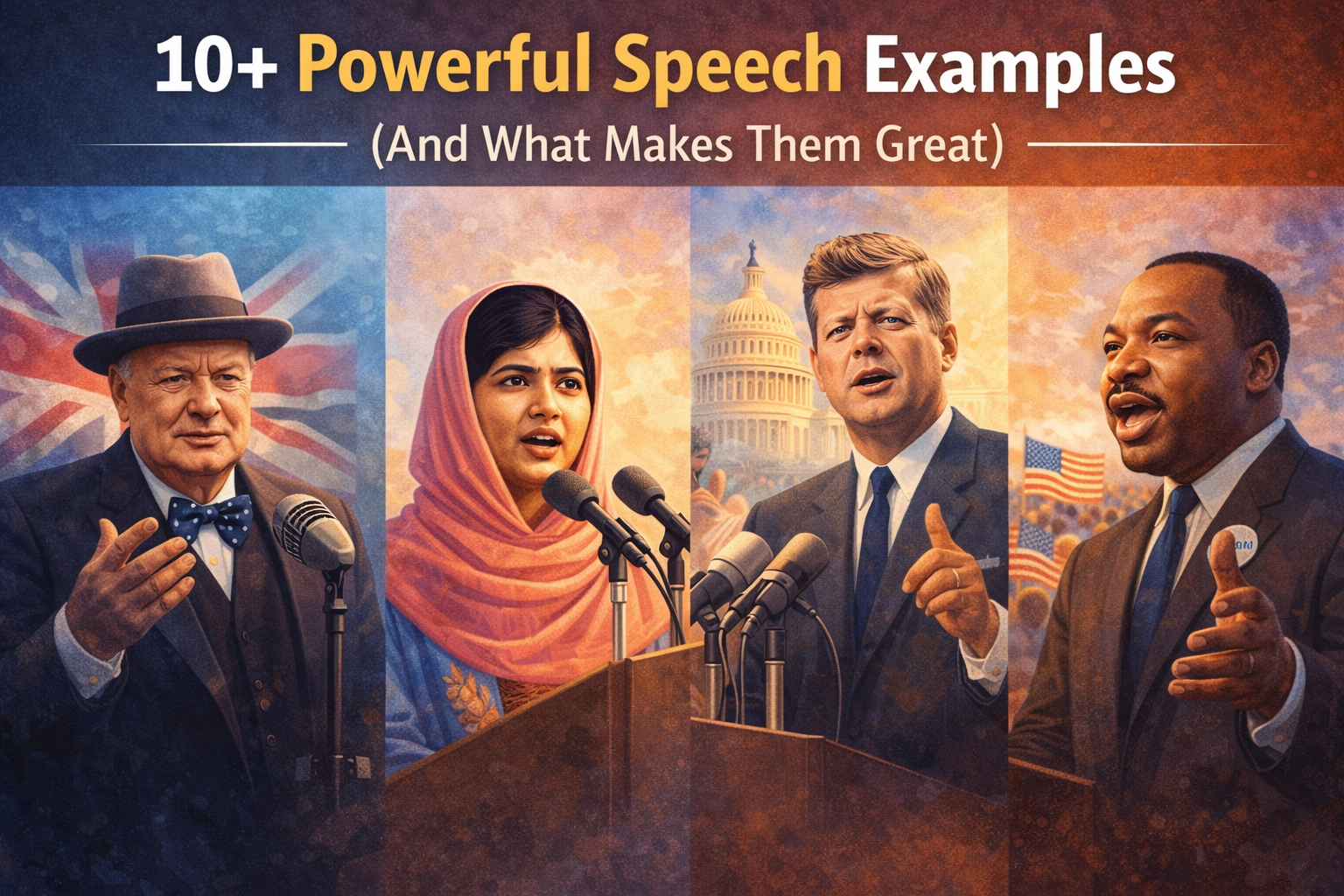
1. Winston Churchill – “We Shall Fight on the Beaches” (1940)
- Context: WWII, following the evacuation at Dunkirk. Morale is critical.
- Core Message: Defiance. Total, unwavering resolve in the face of potential invasion.
- The Technique: Anaphora & Cumulative Force.
- Excerpt: “We shall fight in France, we shall fight on the seas and oceans, we shall fight with growing confidence and growing strength in the air, we shall defend our Island, whatever the cost may be, we shall fight on the beaches, we shall fight on the landing grounds, we shall fight in the fields and in the streets, we shall fight in the hills; we shall never surrender…”
- Why It Works: The relentless repetition of “we shall fight” builds a hypnotic, rhythmic wall of defiance. It doesn’t just state resolve; it enacts it through the cadence of the language. The list grows in scope, creating an overwhelming sense of totality. There is no scenario where Britain gives up.
- Your Takeaway: Use anaphora (repeating a phrase at the start of clauses) to hammer home a core sentiment and build emotional momentum.
2. John F. Kennedy – “Ich bin ein Berliner” (1963)
- Context: Cold War, at the Berlin Wall.
- Core Message: Solidarity with West Berlin against communism.
- The Technique: Symbolic Identification & The Power of “Us vs. Them”.
- Excerpt: “Two thousand years ago, the proudest boast was ‘Civis Romanus sum.’ Today, in the world of freedom, the proudest boast is ‘Ich bin ein Berliner!’… All free men, wherever they may live, are citizens of Berlin, and therefore, as a free man, I take pride in the words ‘Ich bin ein Berliner!'”
- Why It Works: Kennedy didn’t just say “we support you.” He used a foreign language to symbolically become one of them. The Latin quote elevates the act to a historical tradition of civic pride. He redefined the community: “All free men… are citizens of Berlin.” It’s inclusive to allies, exclusive to the oppressor.
- Your Takeaway: Find a symbolic act or phrase that visually and audibly demonstrates alignment with your audience’s identity and struggle.
3. Martin Luther King Jr. – “I Have a Dream” (1963)
- Context: The March on Washington for civil rights.
- Core Message: A vision of racial equality rooted in American and Christian ideals.
- The Technique: Contrasting Imagery & The “Dream” Refrain.
- Excerpt: “I have a dream that one day on the red hills of Georgia, the sons of former slaves and the sons of former slave owners will be able to sit down together at the table of brotherhood… I have a dream that my four little children will one day live in a nation where they will not be judged by the color of their skin but by the content of their character.”
- Why It Works: King masterfully contrasts the “sweltering heat of injustice” with the “oasis of freedom.” He paints the nightmare (“the quicksands of racial injustice”) then overwrites it with the vivid, specific dream. The “I have a dream” refrain acts as a hopeful drumbeat, each iteration adding a new, tangible brushstroke to the painting of a better future.
- Your Takeaway: Use vivid, contrasting metaphors to define the problem and the solution. A powerful, repeated refrain can anchor your speech and become its memorable title.
4. Lou Gehrig – “Farewell to Baseball” (1939)
- Context: A beloved baseball star diagnosed with a fatal disease, addressing a stadium of fans.
- Core Message: Gratitude in the face of tragedy.
- The Technique: Understatement & Inverted “Luck”.
- Excerpt: “Fans, for the past two weeks you have been reading about a bad break. Yet today I consider myself the luckiest man on the face of the earth.”
- Why It Works: The power is in the breathtaking contrast between expectation and reality. We expect self-pity; we get profound gratitude. He lists his blessings—his team, his family, his fans—proving his “luck.” It’s emotionally devastating because of its humility and lack of pretense. The speech is short, simple, and utterly authentic.
- Your Takeaway: Understatement can be more powerful than exaggeration. Framing a setback within a context of gratitude reframes the entire narrative and disarms the audience.
5. Ronald Reagan – “Address on the Challenger Disaster” (1986)
- Context: A nation grieving the shocking loss of the Space Shuttle Challenger.
- Core Message: Mourning with hope; framing loss as part of a courageous journey.
- The Technique: Empathetic Framing & Poetic Allusion.
- Excerpt: “We know we share this pain with all of the people of our country. This is truly a national loss… The crew of the space shuttle Challenger honored us by the manner in which they lived their lives. We will never forget them, nor the last time we saw them, this morning, as they prepared for their journey and waved goodbye and ‘slipped the surly bonds of earth’ to ‘touch the face of God.'”
- Why It Works: Reagan’s genius was in speaking first as a grieving fellow citizen (“We know we share this pain”), not just as a President. He gave the nation permission to grieve. Then, he provided a transcendent frame: quoting the poem “High Flight” transformed a mechanical failure into a spiritual ascent, offering a sense of meaning and sublime closure.
- Your Takeaway: In moments of collective emotion, speak with empathy first. Use literary or poetic references to elevate a circumstance and provide a healing perspective.
6. Steve Jobs – “Stanford Commencement Address” (2005)
- Context: A tech visionary offering life advice to graduates.
- Core Message: Connect the dots looking backward; love what you do.
- The Technique: Simple Story Structure & The Rule of Three.
- Excerpt: “Today I want to tell you three stories from my life. That’s it. No big deal. Just three stories. The first story is about connecting the dots… My second story is about love and loss… My third story is about death…”
- Why It Works: Jobs demystifies the “big speech” by breaking it into three disarmingly simple, personal narratives. The structure is effortlessly clear. Each story has a concrete lesson. His language is conversational, stripped of jargon. The famous line—”Stay Hungry. Stay Foolish.”—works because it’s a short, paradoxical rule of three that challenges conventional wisdom.
- Your Takeaway: You don’t need grand rhetoric. Three clear stories with three clear lessons can structure an incredibly powerful talk. Be conversational. End with a concise, memorable mantra.
7. Chief Seattle – “The Earth is Precious” (1854)
- Context: (Attributed) Response to a land purchase treaty from the U.S. Government.
- Core Message: Interconnectedness of all life; a warning against ecological disregard.
- The Technique: Metaphoric Logic & Kinship with Nature.
- Excerpt: “How can you buy or sell the sky, the warmth of the land? The idea is strange to us… The rivers are our brothers… The air is precious, for all things share the same breath—the beast, the tree, the man, they all share the same breath.”
- Why It Works: It argues from a completely different framework of understanding. It doesn’t use Western legal or economic logic; it uses ecological and familial logic. By framing nature as kin (“brothers”), it makes exploitation unthinkable, a form of fratricide. This shift in perspective is its primary power.
- Your Takeaway: Challenge your audience’s fundamental assumptions. Argue from a different value system (community, legacy, spirituality) to make your point undeniable within that frame.
8. William Faulkner – Nobel Prize Acceptance Speech (1950)
- Context: Accepting the Nobel for Literature in the shadow of WWII and the atomic bomb.
- Core Message: The writer’s duty is to uplift the human heart.
- The Technique: The “Perverse” Contrast & Universal Pronouncement.
- Excerpt: “Our tragedy today is a general and universal physical fear so long sustained by now that we can even bear it… He must teach himself that the basest of all things is to be afraid; and, teaching himself that, forget it forever, leaving no room in his workshop for anything but the old verities and truths of the heart.”
- Why It Works: Faulkner starts by acknowledging the prevailing emotion (fear), then declares the artist’s purpose is its antithesis: to write about “courage and honor and hope and pride and compassion and pity and sacrifice.” The list of “old verities” is a powerful catalog of timeless human strengths. He speaks not as an individual, but as a spokesperson for all artists, giving the speech monumental weight.
- Your Takeaway: Don’t be afraid to make universal pronouncements about the purpose of your field. Contrast the failing of the age with the enduring truth you champion.
9. Elizabeth Gilbert – “Your Elusive Creative Genius” (2009 TED Talk)
- Context: A talk on creativity post the massive success of Eat, Pray, Love.
- Core Message: Separate the artist from the “genius” to manage the pressures of creation.
- The Technique: Historical Anecdote & Conceptual Reframing.
- Why It Works: Gilbert faced a problem: “How do I top that?” Instead of giving generic advice, she reached back to the ancient Roman concept of a “genius” as an external daemon. This reframing is brilliant. It relieves the artist of both the crushing burden of responsibility (“I’m a genius”) and the shame of failure (“I have no genius”). It’s a practical, historical, and psychological model packaged in engaging storytelling.
- Your Takeaway: For complex problems, look for historical or cross-cultural models that offer a fresh frame. A single, well-explained concept can be the core of a revolutionary talk.
10. Dan Pink – “The Puzzle of Motivation” (2009 TED Talk)
- Context: A talk on business and behavioral science.
- Core Message: For creative tasks, traditional rewards (carrots & sticks) often harm performance.
- The Technique: The Scientific Story Arc & The “Case for” Structure.
- Why It Works: Pink uses a classic, persuasive structure: 1. Reveal a gap between what science knows and what business does. 2. Present the compelling evidence (the “puzzle”). 3. Offer the new framework (“autonomy, mastery, purpose”). He turns a potentially dry topic into a detective story. The audience feels the thrill of uncovering a hidden truth about their own workplaces.
- Your Takeaway: Structure your speech as a mystery to be solved. Create cognitive dissonance (“what you think is true isn’t”), then resolve it with satisfying evidence and a new, clearer model.
Part 3: Your Toolkit – The 5 Most Usable Techniques
- Anaphora (Repetition): Repeat a powerful phrase to build rhythm and emphasis. “We shall fight… we shall fight… we shall fight.”
- The Rule of Three: Group ideas in threes. It’s satisfying, memorable, and feels complete. “Government of the people, by the people, for the people.”
- Contrast (Antithesis): Juxtapose opposing ideas to highlight differences. “Ask not what your country can do for you—ask what you can do for your country.”
- Vivid Metaphor: Describe the abstract in concrete terms. “The iron curtain has descended across the continent.”
- The Personal Story: Anchor big ideas in a specific, human narrative. Steve Jobs’ three stories.
Conclusion: The Timeless Code
These speakers weren’t magicians. They were craftspeople using a code—a set of rhetorical and structural tools available to anyone. They understood their audience’s deepest fears and highest hopes, and they built a verbal bridge from one to the other.
The next time you have to speak, don’t just think about what you want to say. Think about Churchill’s defiance, Gehrig’s gratitude, King’s imagery, or Gilbert’s reframing. Steal the technique, not the words. Build your own speech on these timeless foundations.
Your Next Step: Pick one speech from above (find it on YouTube). Listen to it. Now, transcribe just 30 seconds of it. Highlight every use of repetition, contrast, or metaphor. See the code in action.
Your Speech Analysis Lab (Comment Below!):
Let’s practice reverse-engineering. Choose one of the speeches mentioned above (or another famous short speech you admire).
In the comments, answer:
- The Speaker & Occasion:
- One specific rhetorical device you hear (e.g., anaphora, metaphor, rule of three).
- The exact phrase where it’s used.
Example:
- Speaker/Occasion: JFK, Berlin Wall.
- Device: Symbolic Identification.
- Phrase: “Ich bin ein Berliner!”
I’ll provide feedback and help you dig deeper into the technique. Let’s become students of greatness together.