
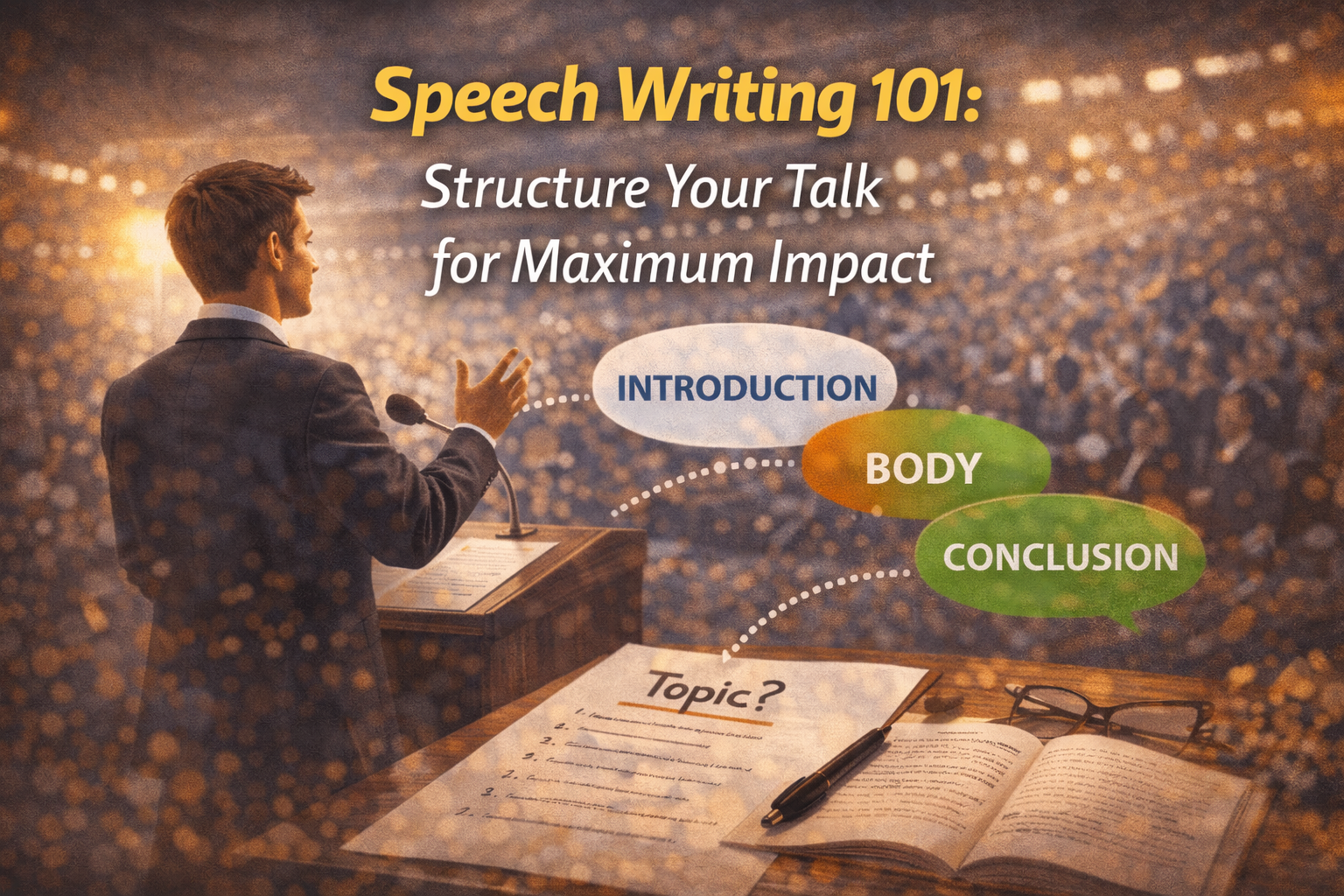
Introduction: The Difference Between a Rambling Monologue and a Memorable Speech
You have 30 seconds.
That’s about how long you have to either capture an audience’s wandering attention or lose it for good. What happens in those 30 seconds—and in the carefully crafted minutes that follow—depends entirely on one thing: structure.
A speech without a clear structure is like a journey without a map. You might eventually get somewhere, but your audience will be lost, frustrated, and disengaged long before you arrive. They’ll remember how confusing it felt, not what you said.
I’ve coached speakers for everything from courtroom closings to investor pitches. The ones who succeed aren’t necessarily the most charismatic; they’re the ones whose talks are built on a rock-solid, invisible framework. This framework guides the audience effortlessly from point A to point B, making complex ideas feel simple and convincing arguments feel inevitable.
In this guide, I’m giving you that exact framework. It’s the same three-act structure used in everything from ancient Greek rhetoric to modern TED Talks. We’ll break it down, component by component, and give you a fill-in-the-blank template. By the end, you’ll know exactly how to build a talk that doesn’t just share information—it creates an experience.
Part 1: The Three-Act Blueprint (Classic, Timeless, Effective)
Every great story has a beginning, middle, and end. Your speech is no different. This three-act structure is the skeleton upon which all the muscle and magic are built.
- Act I: The Introduction (10-15% of your time)
- Job: Hook, engage, and map the journey.
- Goal: Make the audience think, “This matters to me. I need to listen.”
- Act II: The Body (70-80% of your time)
- Job: Deliver, prove, and explain.
- Goal: Walk them through your argument or story with clarity and compelling evidence.
- Act III: The Conclusion (10-15% of your time)
- Job: Reinforce, inspire, and call to action.
- Goal: Leave them with a crystal-clear takeaway and a feeling that compels them to think or act differently.
Let’s put flesh on these bones.
Part 2: Act I – The Introduction (Your Make-or-Break Moment)
Your introduction must do four specific things, in this order:
1. The Hook: Capture Attention Immediately
Forget “Hello, my name is…” Start with value. Here are 5 proven hooks:
- The Provocative Question: “What if everything you knew about productivity was wrong?”
- The Stark Statistic: “Right now, as I speak, over 1 million plastic bottles are being bought every single minute around the world.”
- The Story/Scene: “Two years ago, I found myself alone in a hospital room, staring at a diagnosis that changed everything.”
- The Powerful Quote: “As Maya Angelou famously said, ‘People will forget what you said, people will forget what you did, but people will never forget how you made them feel.'”
- The “Imagine” Scenario: “Imagine opening your door to find the person you admire most, asking for your advice.”
2. The Credibility Link: Why You? Why This?
Briefly establish your right to speak on this topic. This isn’t bragging; it’s building trust.
- “I’ve spent the last decade researching this phenomenon.”
- “This lesson came from a mistake that cost my company $50,000.”
- “Like many of you, I struggled with this for years before finding a solution.”
3. The Core Message (Thesis): State Your Central Idea
This is the one sentence you want to burn into their minds. Make it clear, arguable, and compelling.
- “Today, I want to convince you that true productivity isn’t about doing more, but about doing less—with ruthless focus.”
- “The single biggest barrier to innovation in our school isn’t funding; it’s our fear of failure.”
4. The Roadmap: Preview Your Main Points
Tell them exactly where you’re taking them. This reduces listener anxiety and primes them to follow along.
- “To show you how, we’ll first expose the myth of multitasking, then explore the science of deep work, and finally, I’ll give you one simple system to implement tomorrow.”
- “We’ll look at this through three lenses: historical, economic, and personal.”
Act I Checklist: Hook ✓ | Credibility ✓ | Core Message ✓ | Roadmap ✓
Part 3: Act II – The Body (The Journey of Proof)
This is where you fulfill the promises of your introduction. Organize your main points with a clear pattern.
Choose a Logical Pattern for Your Points:
- Chronological: Past -> Present -> Future.
- Problem -> Cause -> Solution: Define the issue, analyze its roots, propose the fix.
- Logical Argument: Your strongest point, your second strongest, your emotional/clinching point.
- Simple to Complex: Start with the easiest concept to grasp and build up.
The “Point Paragraph” Structure (Repeat for Each Main Point):
For each point in your roadmap, build a mini-speech segment:
- State the Point Clearly: Use a clear transition. “Let’s start by exposing the first myth: multitasking.”
- Explain and Elaborate: Define terms, add context.
- Provide Evidence:
- Data/Stats: “A Stanford study found that heavy multitaskers were significantly worse at filtering out irrelevant information.”
- Story/Anecdote: “I learned this the hard way when I tried to write a report while answering emails…”
- Analogy/Metaphor: “Multitasking is like a computer constantly switching between programs—it creates drag, heats up, and eventually crashes.”
- Expert Testimony: “As productivity expert Cal Newport writes…”
- Connect Back to Core Message: Explicitly tie your evidence to your main argument. “So you see, multitasking doesn’t make us efficient; it scatters our cognitive resources, which is the opposite of the focused work we need.”
The Magic of Transitions: Don’t just jump from point to point. Use bridges:
- “Now that we’ve shattered the multitasking myth, let’s build a better alternative: the science of deep work.”
- “This leads us to our second, and perhaps most surprising, point…”
Part 4: Act III – The Conclusion (The Lasting Impression)
A weak conclusion can unravel a great speech. Your goal is to synthesize, not just summarize.
The 3-Step Conclusion Formula:
- The Signal & Summary:
- Signal the End: Use a phrase like “In closing,” or “As we wrap up.”
- Synthesize Main Points: Don’t just list them. Weave them together to show how they collectively prove your core message.
- “So, we’ve seen that multitasking is a lie, and that deep, focused work is the scientifically-backed path forward.”
- Reinforce the Core Message: Restate your thesis in a fresh, more powerful way, now loaded with the weight of the evidence you’ve provided.
- “It becomes clear: in a world obsessed with busyness, your superpower is singular, uninterrupted focus.”
- The Clincher (Choose One):
- The Call to Action (Most Powerful): Tell them exactly what to do. *”So tomorrow, I challenge you to block one 90-minute session of focused time. Close everything. Just work. See what happens.”*
- The Vision of the Future: Paint a picture of the better world your idea creates. “Imagine a team, a company, a society that valued depth over distraction. What could we build?”
- The Full-Circle Callback: Refer back to your opening hook or story, showing transformation or resolution. “And that person in the hospital bed? They learned that healing, like anything meaningful, requires focused, patient attention—one day at a time.”
End strong. Then stop. Smile. Accept the applause. Don’t add “That’s it!” or “Sorry, I went over.”
Part 5: The Complete Template & a Real Example
> > DOWNLOAD: [Your Fill-in-the-Blank Speech Structure Template (PDF)] <<
Example Topic: The Importance of Failure
- Hook (Question): “What do a successful vaccine, the pacemaker, and chocolate chip cookies all have in common?”
- Credibility: “As someone who has started two failed businesses before my third succeeded, I’ve become a student of failure.”
- Core Message: “I believe that our greatest innovations and personal growth are not born from success, but from intelligent failure.”
- Roadmap: “Let’s look at how failure fuels discovery, builds resilience, and teaches lessons success never can.”
- Body Point 1 (Discovery): State point -> Explain (many discoveries are accidents) -> Evidence (Penicillin, Post-it Notes) -> Connect (Without room for ‘failed’ experiments, we lose innovation).
- Body Point 2 (Resilience): State point -> Explain (psychological “anti-fragility”) -> Evidence (Study on entrepreneurs, personal story) -> Connect (Each failure is a stress test that makes you stronger).
- Body Point 3 (Lesson-Teacher): State point -> Explain (Success confirms, failure interrogates) -> Evidence (Analogy: a failed bridge design teaches more than a successful one) -> Connect (The data from failure is invaluable).
- Conclusion:
- Signal & Summary: “In the end, failure isn’t the opposite of success; it’s the essential curriculum for it.”
- Reinforce Message: “By re-framing failure not as a verdict but as feedback, we unlock our true potential.”
- Clincher (Call to Action): “This week, I dare you to share a story of a failure and the lesson it taught you. Let’s start a conversation that values the attempt as much as the outcome.”
Conclusion: Structure Sets You Free
This might seem formulaic at first. But remember: Structure isn’t a cage for your creativity; it’s the launchpad. Just as a sonnet’s 14-line structure has produced some of the world’s most beautiful poetry, this speech framework gives you the freedom to be compelling, confident, and clear.
You now have the blueprint. The next step is to use it. Take an idea you care about and plug it into the template. You’ll be shocked at how quickly a powerful talk comes together.
Your Next Speech: Start with your Core Message. Everything else flows from that one, powerful sentence.
Let’s Structure a Speech Together (Comment Below!):
Pick a topic you might speak on (e.g., “why my town needs a community garden,” “the book that changed my perspective,” “a skill more people should learn”).
In the comments, outline just the skeleton:
- Your proposed Hook:
- Your one-sentence Core Message:
- Your 3-Point Roadmap: First, we’ll… second, we’ll… finally, we’ll…
I’ll provide feedback on the strength and clarity of your structure. Let’s build your next great talk!
