
Introduction: The Power of a Well-Written Speech
Imagine this: You’re standing backstage, your heart pounding. In a few minutes, you’ll step in front of a crowd. But instead of fear, you feel a spark of excitement. You know your words are powerful. You know your message will connect. Why? Because you didn’t just write a speech—you crafted an experience.
Whether it’s a class presentation, a wedding toast, or a business pitch, a great speech can move people. It can change minds, inspire action, and be remembered for years.
But how do you get from a blank page to a standing ovation? It’s not magic. It’s a process. In this guide, I’ll walk you through the same process I’ve used to help students win competitions and professionals deliver keynotes. We’ll break it down into seven clear steps.
Let’s turn your next speaking opportunity into your moment to shine.
Step 1: Know Your Audience and Purpose (The Foundation)
Before you write a single word, you must answer two critical questions:
1. Who is listening? (Audience)
- Are they classmates, teachers, family, or professionals?
- What do they already know about your topic? What do they need to know?
- What are their interests, beliefs, and possible objections?
2. Why are you speaking? (Purpose)
- To inform? (Teach them something new)
- To persuade? (Change their opinion or motivate action)
- To entertain? (Make them laugh and enjoy)
- To inspire? (Touch their emotions and uplift)
Action Step: Write one sentence that combines both. Example: “I am speaking to my classmates (audience) to persuade them that volunteering improves our community and their own lives (purpose).”
This sentence becomes your compass, ensuring every part of your speech resonates with the people in front of you.
Step 2: Choose a Clear, Compelling Core Message
Your core message is the one idea you want your audience to remember when they leave the room. It’s the heart of your speech.
How to find it: Ask yourself, “If the audience remembers only one thing, what should it be?”
A strong core message is:
- Simple: Easy to understand and repeat.
- Specific: Not vague or generic.
- Significant: It matters to your audience.
Examples:
- Weak: “Volunteering is good.”
- Strong: “Volunteering at the local food bank doesn’t just feed the hungry—it feeds your own sense of purpose and connects you to your community in a profound way.”
This core message will eventually become the backbone of your thesis statement.
Step 3: Build a Memorable Structure (The Speech Blueprint)
People don’t remember disjointed facts. They remember stories and structured arguments. Use this classic structure as your template:
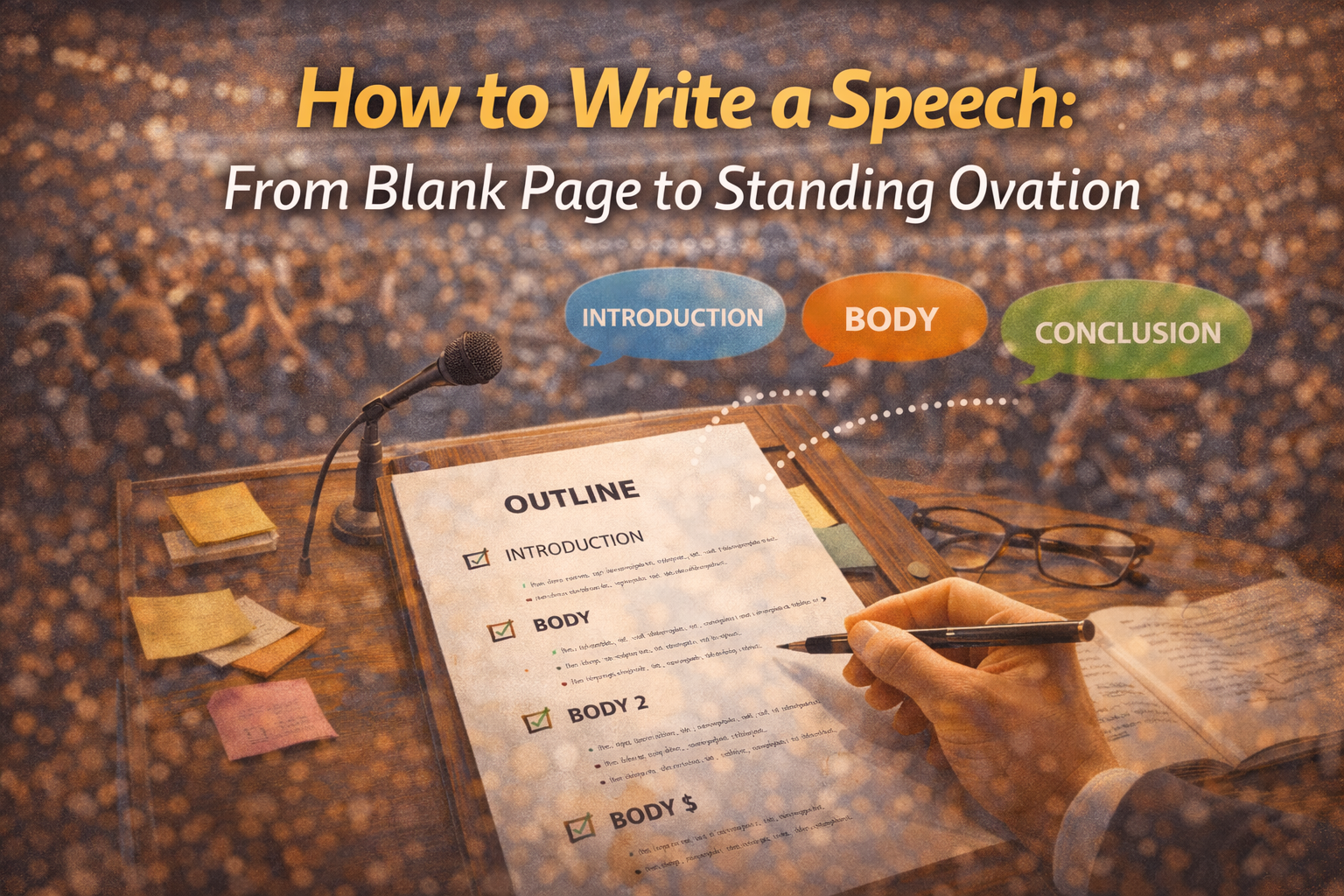
The 3-Act Speech Structure
- Introduction (The Hook – 10-15% of your time)
- Grab Attention: Start with a startling statistic, a provocative question, a short story, or a powerful quote.
- Establish Credibility: Briefly share why you’re qualified to speak on this (personal experience, research).
- State Your Core Message: Clearly present your main idea (thesis).
- Preview Your Points: Tell them what you’ll cover. (“Today, I’ll share three reasons why…”)
- Body (The Journey – 70-80% of your time)
- Point 1: Your strongest argument or most compelling story.
- State it.
- Support it with evidence: stories, data, examples, analogies.
- Explain why this matters to the audience.
- Point 2: Your second strongest point.
- Point 3: A point that addresses counterarguments or adds emotional depth.
- Use transitions to guide your audience from one point to the next. (“Not only does this matter because of X, but also because of Y…”)
- Point 1: Your strongest argument or most compelling story.
- Conclusion (The Call to Action – 10-15% of your time)
- Signal the End: Use a phrase like “In conclusion…” or “As we wrap up…”
- Summarize Key Points: Briefly recap your main arguments, linking them back to your core message.
- Reinforce the Core Message: Restate it in a fresh, memorable way.
- End with Impact: A call to action, a visionary look to the future, or a powerful final story that leaves them thinking.
> > DOWNLOAD: [Click here for our Fill-in-the-Blank Speech Outline Template (PDF)] <<
Step 4: Write for the Ear, Not the Eye
This is the critical difference between an essay and a speech. Your words are meant to be heard, not read.
Techniques for Oral Language:
- Use Shorter Sentences: They are easier to follow and more powerful.
- Employ Rhetorical Devices:
- Repetition: Repeat key phrases for emphasis. (“I have a dream…”)
- Rule of Three: Group ideas in threes. (“Government of the people, by the people, for the people.”)
- Analogies and Metaphors: Make abstract ideas concrete. (“Life is like a box of chocolates.”)
- Use Contractions: “Don’t” instead of “do not.” It sounds natural.
- Ask Rhetorical Questions: Engage the audience’s mind. “Have you ever wondered…?”
Pro-Tip: As you write, read every sentence aloud. If it feels awkward to say or is hard to breathe through, rewrite it.
Step 5: Weave in Stories and Examples (The Emotional Glue)
Facts tell, but stories sell. Stories are the most powerful tool a speaker has. They make your message relatable, memorable, and emotionally resonant.
How to include a story:
- Set the Scene: Briefly describe the time and place.
- Introduce the Character: Often, this is you or someone the audience can empathize with.
- Present the Struggle or Challenge: What was the problem or conflict?
- Show the Resolution or Lesson: What changed? What was learned?
Every main point in your speech should be supported by at least one clear example or a short, relevant story.
Step 6: Draft Your Opening and Closing Last
Paradoxically, it’s often easier to write your introduction and conclusion after you’ve written the body. Now you know exactly what you’re introducing and what you’re concluding.
Crafting an Unforgettable Opening
Your first 60 seconds decide if the audience tunes in or tunes out. Avoid: “Hello, my name is… today I’m going to talk about…”
Strong Openers:
- A Personal Anecdote: “Last year, I stood at a podium just like this, my hands trembling so badly I could barely hold my notes…”
- A Startling Statistic: “Did you know that 75% of people rank public speaking as their number one fear?”
- A Powerful Quote: “As Maya Angelou once said, ‘People will forget what you said, people will forget what you did, but people will never forget how you made them feel.'”
Crafting a Resonant Closing
Your last words are what linger. Avoid: “Well, that’s all I have. Thanks for listening.”
Strong Closers:
- The Full-Circle Callback: Refer back to your opening story or statistic, showing how the journey changed it.
- The Clear Call to Action: Tell them exactly what you want them to do, think, or feel. “So the next time you see a volunteer opportunity, I challenge you to say yes.”
- The Visionary Look Forward: Paint a picture of the future if your idea is adopted. “Imagine a school where every student feels this sense of purpose…”
Step 7: Revise, Practice, and Prepare for Delivery
Writing is only half the battle. Now, you must own the speech.
- Revise for Clarity and Flow: Read the entire speech aloud multiple times. Cut any jargon, long-winded sentences, or confusing parts.
- Create Speaking Notes: Never read your speech word-for-word. Use bullet points on note cards or a single sheet of paper with key phrases, statistics, and transition words.
- Practice with a Timer: Time each section. Ensure you are within your limits. Practice until you can speak naturally from your notes, not memorized text.
- Practice with an Audience: Recruit a friend or family member. Their feedback on your clarity and engagement is invaluable.
- Prepare for Tech: If using slides, keep them simple (images, keywords). Practice with the clicker. Have a backup plan.
Remember: Practice doesn’t make perfect. It makes permanent. Practice enough so that even if nerves hit, your muscle memory carries you through.
Conclusion: Your Voice Matters
You started with a blank page and now have a complete, structured speech designed to connect with an audience. You’ve learned that a great speech is built on knowing your audience, having a clear message, and structuring it for the human ear.
The final step is to share it. Speak with conviction. Speak with passion. Your ideas deserve to be heard.
Your Next Step: Choose an upcoming event—a class presentation, a club meeting, even a dinner table conversation—and draft a 2-minute speech using this guide. The only way to become a better speaker is to speak.
Let’s Practice Together (Comment Below!):
Think of a topic you might have to speak about. In the comments, write:
- Your intended audience and purpose (from Step 1).
- Your one-sentence core message.
- One story or example you could use to support it.
I’ll give feedback and help you refine your ideas. Let’s get your speech started!
